Podium vs The Doc Mirror: An Honest Comparison
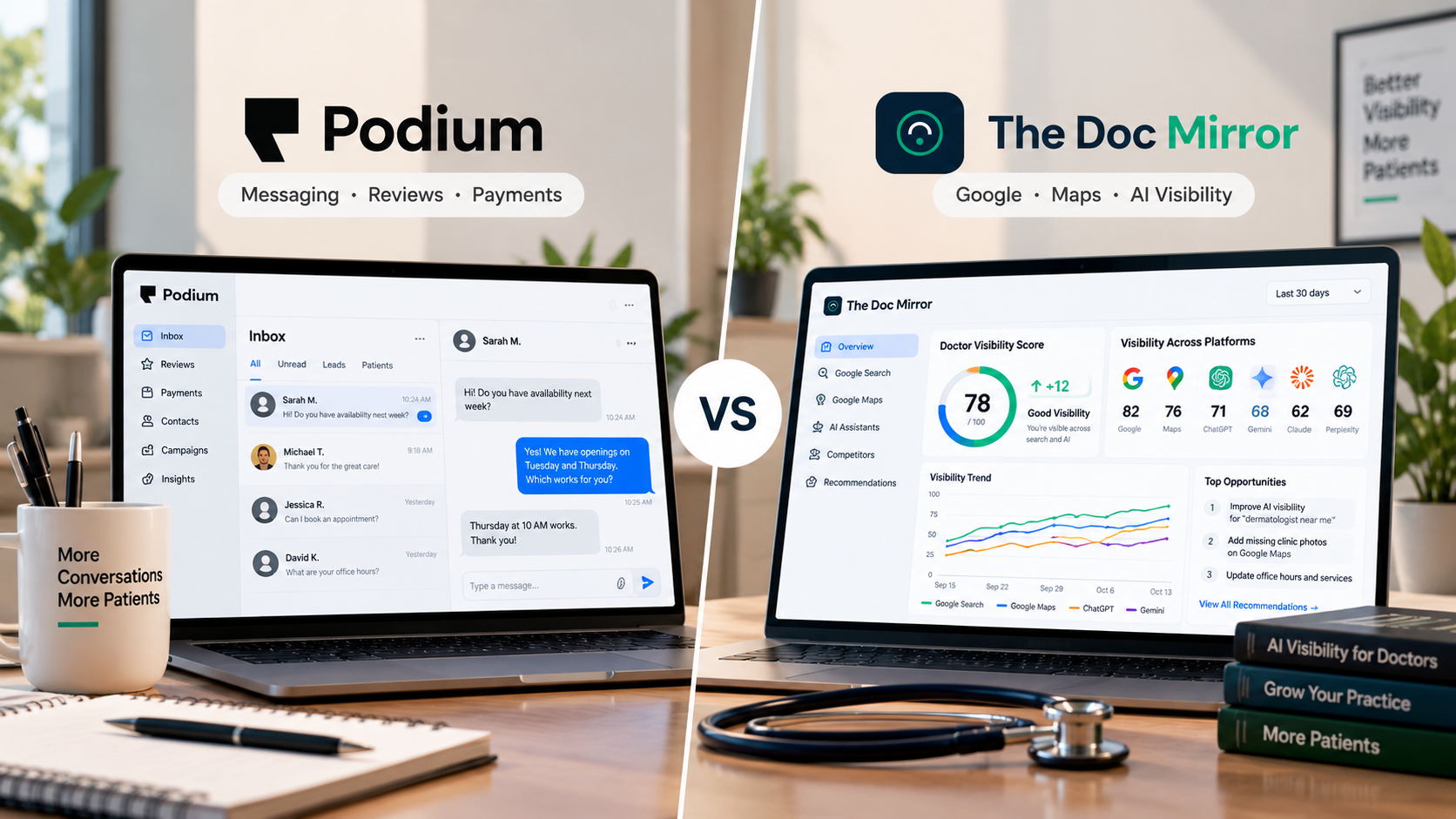
Podium and The Doc Mirror are not competing for the same job, even though both show up when a doctor searches for reputation or marketing software. Podium is an established messaging and reputation platform used across many local business categories, including some medical practices. The Doc Mirror is built specifically to measure how doctors appear on Google, Google Maps, and AI assistants like ChatGPT, Gemini, Claude, and Perplexity.
This page is a factual comparison, not a takedown. Podium is a real, well-known company with a broad customer base, and plenty of practices use it successfully for messaging and reviews. The question worth answering here is not which tool is "better" in the abstract. It is which problem each one actually solves, and whether your practice needs one, the other, or both.
What Podium Does Well
Podium built its reputation as a business messaging and communication platform, letting local businesses text customers, collect payments, and manage reviews from one inbox. It serves a wide range of industries, from auto repair shops to dental offices to retail chains, and that breadth is part of its appeal.
For a practice that wants one system to handle inbound patient texting, review requests, and basic payment collection, a general-purpose platform like Podium has real advantages. It has had years to refine its messaging workflows and integrations across many business types, not just healthcare. That maturity tends to show up in polish: fewer rough edges in the day-to-day inbox experience, and integrations with a wide range of other business software.
Podium also benefits from scale. A platform built for thousands of businesses across dozens of industries can invest in infrastructure, uptime, and support in ways that a narrower, newer tool cannot always match on day one. [VERIFY CURRENT PODIUM PRICING/FEATURES BEFORE PUBLISHING] for the specific plans, integrations, and support tiers available to medical practices today, since these change over time and Podium does not publish every detail publicly.
None of this makes Podium the right fit for every practice, but it is a legitimate, established option worth understanding on its own terms before comparing it to anything else.
What The Doc Mirror Does Well
The Doc Mirror exists to answer a single question doctors increasingly ask: what do patients actually see about me when they search Google or ask an AI assistant? That question did not really exist five years ago in its current form. Patients now routinely ask ChatGPT or Gemini things like "who is a good pediatrician near me" or "is this doctor accepting new patients," and the answer an AI assistant gives is often the only impression a prospective patient forms before booking.
The Doc Mirror audits a practice's visibility across three layers that matter for doctors specifically: Google Search results, Google Maps and the Google Business Profile listing, and how AI assistants describe or recommend the practice when asked relevant questions. It combines those into a single visibility score, so a doctor can see, in one number, roughly where they stand and what is dragging the score down.
This is a narrower job than what Podium does, and that is by design. The Doc Mirror does not try to replace a practice's texting system or payment collection. It focuses on one problem: understanding and improving how doctors are found and described online, including in the AI assistants that are becoming a real referral source. That focus lets it go deeper on healthcare-specific visibility signals, like how a practice's specialty, credentials, and location cues show up in AI-generated answers, than a general-purpose platform built for many industries is built to do.
The Key Structural Difference
The clearest way to understand the difference is structural. Podium is a broad, multi-vertical communication and reputation platform. It was not built for medicine specifically, and it applies largely the same messaging and review workflow whether the customer is a dentist, a plumber, or a furniture store.
The Doc Mirror is a healthcare-specific AI-visibility tool. It was built from the ground up to measure how doctors and medical practices appear across Google, Google Maps, and AI assistants, with a single visibility score as the output. It is fair to call it the first AI-visibility platform built specifically for doctors, since it was designed around that exact question rather than adapted to it after launch.
Put simply: Podium helps a practice communicate with patients and collect reviews. The Doc Mirror helps a practice understand and improve what patients and AI assistants see about them before that communication even starts. Those are related problems, but they are not the same problem, and a tool built for one is not automatically equipped to solve the other well.
Feature Comparison Table
| Category | Podium | The Doc Mirror |
|---|---|---|
| Core focus | Business messaging, reviews, and payments across many industries | AI and search visibility measurement built for doctors |
| Built for healthcare specifically | No, general-purpose platform adapted for many verticals | Yes, purpose-built for medical practices |
| Patient texting and inbox messaging | Strong category feature, mature multi-industry product | Not a core function |
| Payment collection | Available as part of the broader platform | Not offered |
| Google Business Profile visibility tracking | [VERIFY CURRENT PODIUM PRICING/FEATURES BEFORE PUBLISHING] | Yes, core feature |
| AI assistant visibility (ChatGPT, Gemini, Claude, Perplexity) | Not a stated focus area | Yes, core feature |
| Single visibility score | Not a stated feature | Yes |
| Multi-location and multi-industry support | Strong category strength, built for scale across business types | Focused on individual and group medical practices |
| Review request automation | [VERIFY CURRENT PODIUM PRICING/FEATURES BEFORE PUBLISHING] | Not a core function, complements existing review tools |
| Best suited for | Practices wanting one broad communication and reputation tool | Practices wanting to understand and fix AI and search visibility specifically |
Podium's breadth and product maturity across many business types is a genuine category strength, particularly for multi-location practices or groups that also want messaging and payments in one place. That strength is a reasonable reason to choose it, even alongside The Doc Mirror's narrower, healthcare-specific focus.
Pricing Comparison (as of 2026)
Pricing for both categories varies by practice size, number of locations, and contract terms, so treat the figures below as directional rather than final.
Podium pricing, as of 2026: [VERIFY CURRENT PRICING]. Podium has historically sold to businesses through tiered plans with pricing that scales by location and feature set, but exact current numbers should be confirmed directly with Podium before making any decision.
The Doc Mirror pricing, as of 2026: [VERIFY CURRENT PRICING]. The Doc Mirror offers a Full Report that shows a practice's current visibility score across Google, Google Maps, and AI assistants as a starting point, with paid plans built around ongoing monitoring and improvement.
Because the two tools solve different problems, comparing them purely on price without comparing what each price includes is not a useful exercise. A lower monthly cost on a tool that does not measure AI visibility at all is not automatically the better value for a practice trying to solve that specific problem.
When to Pick Podium
Podium is a reasonable choice if a practice's main gap is patient communication: slow response times to texts and calls, no centralized inbox, or a need to collect payments through the same system used for messaging. It also makes sense for multi-location groups that operate across other industries too, or that already have Podium in place for a related business and want to extend it into a medical location.
If AI visibility and how a practice appears to ChatGPT or Gemini users is not currently a concern, and the priority is simply faster, more organized patient communication, Podium's broader feature set may cover what is needed. For a wider look at how review-focused tools in general compare, see where Podium fits among review tools generally.
When to Pick The Doc Mirror
The Doc Mirror is the right choice for a practice that wants a clear, healthcare-specific answer to how it is being found and described, particularly as AI assistants become a bigger part of how patients search. If a practice has never measured its AI visibility, does not know its current visibility score, or suspects it is being described inaccurately or incompletely by ChatGPT or Gemini, that is exactly the gap The Doc Mirror is built to close.
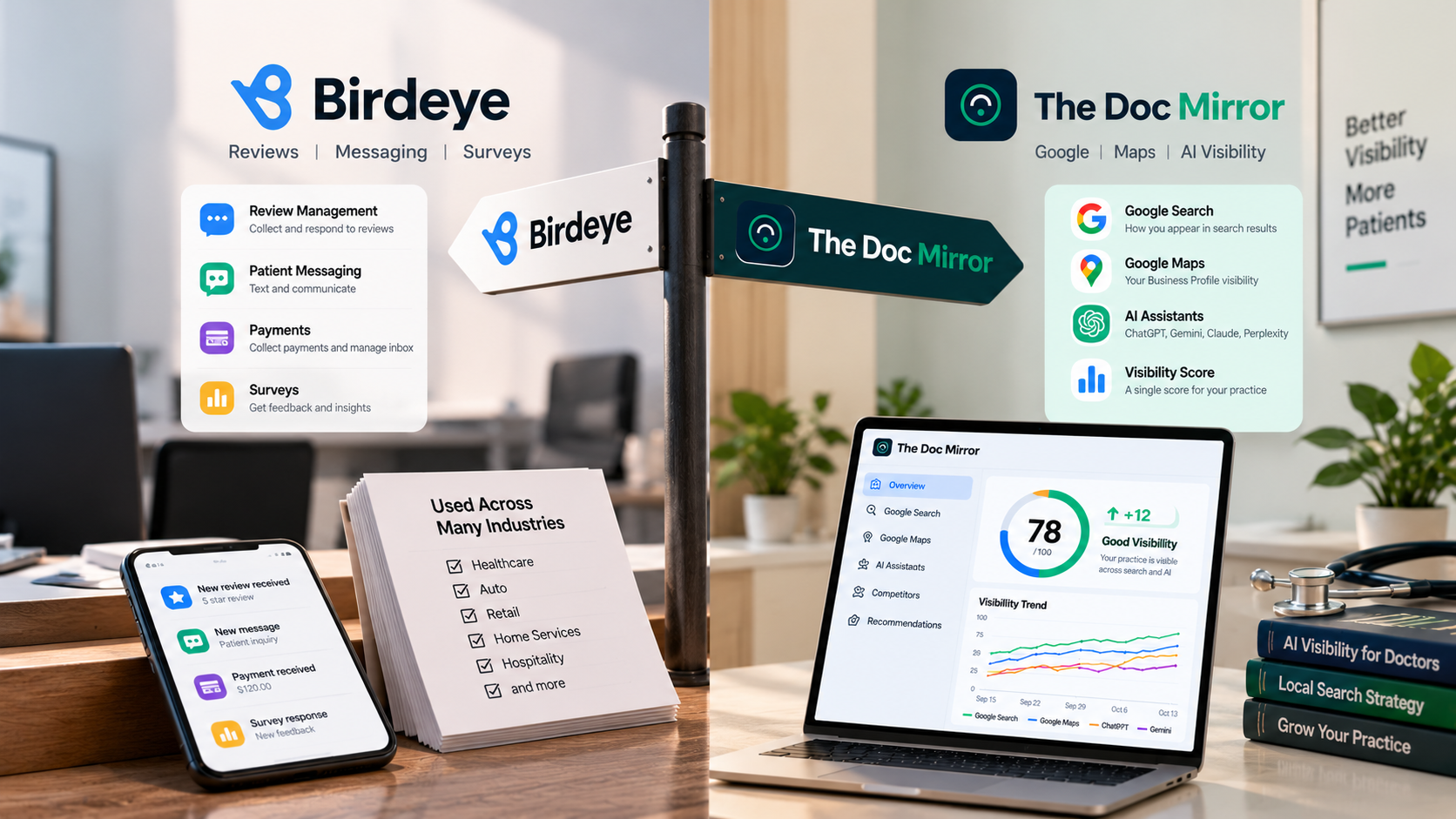
It also makes sense for a practice that already has a messaging or review tool in place, like Podium, and wants an additional, focused layer on top of it that tracks the AI-visibility problem specifically. For a comparison against another established name in this space, how Birdeye compares instead covers a different general-purpose alternative using the same honest framework.
Can You Use Both
Yes, and for many practices this is the more accurate answer than picking one over the other. Podium and The Doc Mirror solve different problems: one handles day-to-day patient communication and review collection, the other measures and improves how a practice is described across search and AI assistants. Running both is not redundant, since neither tool replaces what the other does.
A practice using Podium for messaging can still have significant blind spots in how it appears to AI assistants, since messaging volume and review counts do not directly translate into accurate AI-generated summaries. Layering The Doc Mirror on top gives that practice visibility into a layer Podium was not built to measure. The decision between the two is not really either-or. It is about which problem to solve first, and whether the budget and team bandwidth allow for both.
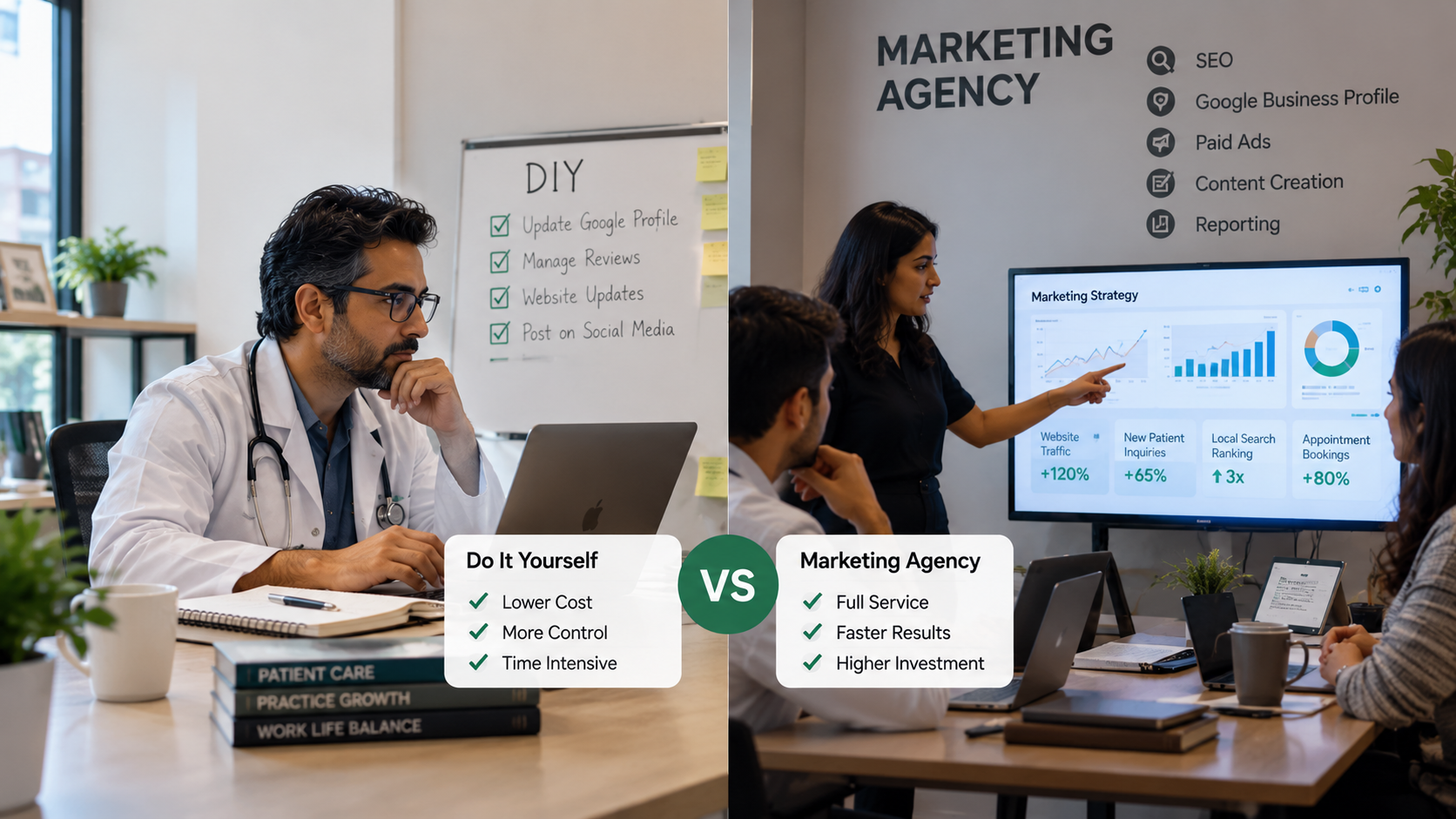
For practices weighing whether to handle all of this in-house or bring in outside help, the agency-vs-DIY question broadly is worth reading before deciding how to staff either tool.
Conclusion
Podium and The Doc Mirror are both legitimate tools, but they answer different questions. Podium helps a practice communicate with patients and manage reviews across a broad, multi-industry platform. The Doc Mirror measures and improves how doctors appear across Google, Google Maps, and AI assistants, with a healthcare-specific focus that a general-purpose tool is not built to match.
The right choice depends on the problem in front of you. If it is communication and review volume, Podium's category strengths are worth evaluating on their own merits. If it is understanding what patients and AI assistants actually see when they look for a doctor like you, that is the problem The Doc Mirror was built to solve.
Get Your Full Report
The clearest way to see where your practice stands is to look at the actual numbers. See The Doc Mirror's own report to get your current visibility score across Google, Google Maps, and AI assistants like ChatGPT and Gemini, and see exactly what is helping or hurting how patients find you.
By the The Doc Mirror team