Birdeye vs The Doc Mirror: What's the Difference for Doctors?
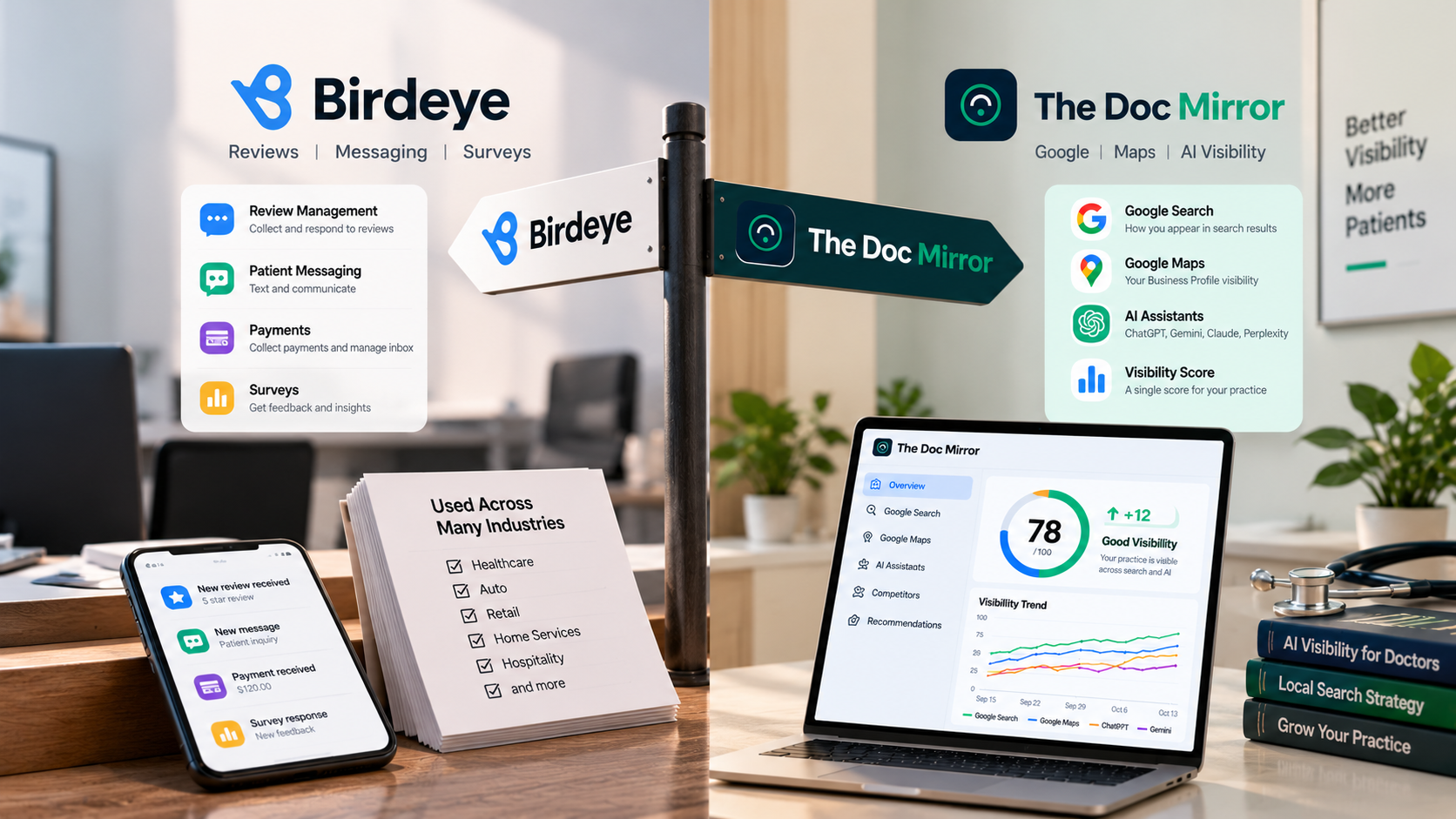
Birdeye is a reputation management and customer experience platform used across many industries, while The Doc Mirror is built only to measure how doctors appear on Google, Google Maps, and AI assistants. That is the core difference, and it shapes everything else about how the two tools work and who they fit best.
Birdeye is a legitimate, established company with a long track record in reputation and reviews software. It is not a niche or unproven product, and practices that use it for general reputation management have real reasons for choosing it. This article is not an attack on Birdeye. It is an honest comparison of what each tool is actually built to do, so a doctor evaluating both can make an informed decision instead of guessing from marketing pages.
The short version: Birdeye serves a wide range of businesses, from car dealerships to dental groups to multi-location retail chains, with reputation and customer-experience tools that apply broadly. The Doc Mirror serves one audience only, doctors and medical practices, and focuses on one specific and increasingly important problem, how a practice shows up when a patient asks Google or an AI assistant like ChatGPT for a recommendation. Both are useful. They are not solving the same problem.
What Birdeye Does Well
Birdeye operates in the broad reputation management and customer experience category, and general-purpose platforms in this space typically bring a few structural strengths that come from serving many industries at once.
Wide industry experience. Because Birdeye works across dozens of verticals, retail, automotive, healthcare, legal, hospitality, and more, its underlying platform has typically been refined through a much larger volume of customer feedback and use cases than a niche tool serving one industry alone. That breadth often translates into a more mature, feature-rich core product.
Enterprise and multi-location scale. General reputation platforms built for large customer bases tend to invest heavily in enterprise-grade capabilities: role-based permissions across dozens or hundreds of locations, franchise-level reporting, and integrations with large customer relationship management systems. For a group practice or a healthcare organization with many sites, this kind of scale infrastructure can matter more than industry-specific depth.
Broader reputation and review workflows. Platforms in Birdeye's category generally offer a wide set of reputation tools, review generation, review response, listings management, messaging, and customer surveys, built to cover the full span of a business's public-facing reputation rather than one narrow slice of it. [VERIFY CURRENT BIRDEYE PRICING/FEATURES BEFORE PUBLISHING] for the exact current feature set, since specific capabilities and packaging can change.
None of this is a knock on doctors who use Birdeye today. A broad, well-established platform with wide industry experience is a defensible choice, particularly for a large multi-location group that needs enterprise-level reputation infrastructure more than it needs healthcare-specific AI-visibility tracking.
What The Doc Mirror Does Well
The Doc Mirror is not trying to be a general reputation platform, and it is not trying to replace every function a broad tool like Birdeye covers. It is built around one job: showing a doctor exactly how they appear to patients searching on Google, Google Maps, and AI assistants such as ChatGPT, Google Gemini, Claude, and Perplexity.
That focus produces a few specific advantages for a medical practice.
A single visibility score built for one industry. The Doc Mirror combines Google Business Profile data, review signals, and AI-assistant responses into one visibility score, calculated specifically around how patients search for doctors rather than how consumers search for a restaurant or a car dealership.
AI-assistant tracking as a first-class feature, not an add-on. A growing share of patients now ask an AI assistant a question like "who is a good cardiologist near me" instead of typing it into a search bar. The Doc Mirror audits how a practice is described, and whether it is mentioned at all, across multiple AI assistants, and reports that as a clear, specific finding rather than a general reputation metric.
Built around how medical practices actually operate. From specialty-specific directories to the way patients evaluate a doctor differently than they evaluate a retail business, The Doc Mirror's reporting reflects healthcare search behavior specifically, not a healthcare module bolted onto a platform built for other industries.
A Full Report a doctor can act on directly. Instead of a dashboard full of general reputation metrics, The Doc Mirror produces a Full Report that shows exactly where a practice is strong, where it is missing, and what to fix first, focused entirely on visibility rather than broader customer experience management.
The Key Structural Difference
Birdeye is a multi-vertical platform serving many industries with a broad set of reputation and customer experience tools. The Doc Mirror is a single-purpose tool built only for doctors, measuring one thing specifically: how a practice appears across Google, Google Maps, and AI assistants.
This is not a claim that one company is better than the other. It is a factual difference in scope and design intent. A broad platform is built to generalize across industries, which brings real strengths in scale and maturity. A narrow, purpose-built tool is designed to go deep on one problem for one audience, which brings real strengths in relevance and precision. Which structure serves a given practice better depends on what that practice actually needs.
Feature Comparison Table
| Category | Birdeye | The Doc Mirror |
|---|---|---|
| Primary focus | Broad reputation and customer experience management across many industries | AI and search visibility measurement built only for doctors |
| Industry specialization | General-purpose, with healthcare as one of many supported verticals | Healthcare only, no other industries served |
| AI assistant visibility tracking (ChatGPT, Gemini, Claude, Perplexity) | [VERIFY CURRENT BIRDEYE PRICING/FEATURES BEFORE PUBLISHING] | Core feature, tracked and reported specifically |
| Google Business Profile and Google Maps visibility scoring | [VERIFY CURRENT BIRDEYE PRICING/FEATURES BEFORE PUBLISHING] | Core feature, combined into a single visibility score |
| Review monitoring and response | [VERIFY CURRENT BIRDEYE PRICING/FEATURES BEFORE PUBLISHING], generally a core strength of platforms in this category | Included as part of visibility reporting, not the primary focus |
| Multi-location, enterprise-scale reputation management | Likely a general category strength, given the platform's broad enterprise customer base | Built for individual practices and small groups, not designed as enterprise franchise infrastructure |
| Customer surveys and broader customer experience tools | [VERIFY CURRENT BIRDEYE PRICING/FEATURES BEFORE PUBLISHING] | Not a core feature, out of scope |
| Single visibility score specific to doctor search behavior | Not the product's design intent | Core deliverable |
| Actionable Full Report focused on what to fix first | [VERIFY CURRENT BIRDEYE PRICING/FEATURES BEFORE PUBLISHING] | Core deliverable |
Multi-location, enterprise-scale reputation infrastructure is one area where a broad, established platform serving many large customers generally has an edge, since that kind of scale is built into the category rather than something a focused tool prioritizes.
Pricing Comparison (as of 2026)
Pricing for both categories varies by practice size, number of locations, and contract terms, so treat the figures below as a starting framework rather than a quote.
Birdeye pricing, as of 2026: [VERIFY CURRENT PRICING]. Platforms in this category are typically priced per location or on a custom enterprise quote, and exact tiers, minimums, and included features should be confirmed directly with Birdeye before comparing.
The Doc Mirror pricing, as of 2026: [VERIFY CURRENT PRICING]. Pricing is structured around individual practices, and the best way to see current numbers and what is included at each tier is to request a Full Report directly.
Because pricing structures and packaging change over time for any vendor, do not rely on a comparison article for exact current numbers. Confirm directly with each company before making a decision.
When to Pick Birdeye
Birdeye is a reasonable choice for a large, multi-location healthcare organization that needs broad customer experience management alongside reputation tools, especially if the organization already operates other business lines that Birdeye also serves. It also fits a practice that wants one platform to handle surveys, messaging, and listings management across many locations, not just visibility tracking, and that values a long-established, broadly proven platform over a healthcare-specific one.
When to Pick The Doc Mirror
The Doc Mirror fits a doctor or medical practice that wants a clear, specific answer to one question: how do patients actually find and see me on Google and on AI assistants right now. It fits practices concerned that a strong star rating does not necessarily mean an AI assistant is recommending them, and it fits doctors who want a report built entirely around healthcare search behavior instead of a general reputation dashboard adapted for medical use.
It is also the more direct choice for a solo or small-group practice that does not need enterprise-scale, multi-vertical reputation infrastructure and would rather pay for depth on one problem than breadth across many.
Can You Use Both?
Yes, and some practices do. A practice already running Birdeye or a similar broad reputation platform for review management and customer experience can still run The Doc Mirror alongside it, since the two tools measure different things. Birdeye-type platforms generally focus on reviews, listings, and customer experience workflows, while The Doc Mirror focuses specifically on the visibility score across Google and AI assistants. There is no inherent conflict in using both, and whether it makes sense comes down to budget and how much value the AI-visibility layer adds on top of what a broader tool already reports.
Conclusion
Birdeye and The Doc Mirror are not competing for the same job. Birdeye is a broad, multi-vertical reputation and customer experience platform with real strengths in scale and industry breadth. The Doc Mirror is a single-purpose tool built only for doctors, measuring how a practice appears across Google, Google Maps, and AI assistants like ChatGPT, Google Gemini, Claude, and Perplexity. The right choice depends on whether a practice needs broad reputation infrastructure or a focused, healthcare-specific visibility score. For a wider look at where Birdeye fits among review tools generally, see where Birdeye fits among review tools generally.
The Doc Mirror shows exactly how patients find and see a practice on Google and on AI assistants, a layer most general reputation platforms were not built to measure. See The Doc Mirror's own report and see precisely where the gaps are.
By the The Doc Mirror team