How to Do a Medical Practice Competitor Analysis, Step by Step
Patients rarely pick a provider in isolation anymore. Someone searching for a pediatric dentist or a dermatologist typically has two or three clinics open in browser tabs at once, comparing star ratings, photos, and how quickly each practice responds to a question online. A medical practice competitor analysis is simply the discipline of looking at that same comparison from your side of the screen, on purpose, instead of finding out about it secondhand when a patient mentions "the other place looked more put-together."
This isn't the same exercise as a side-by-side scorecard you run once and file away, and it isn't a tools roundup either. Done right, it's a repeatable form of competitor research for doctors: a specific answer to who you're actually competing with online, what to look at when you study them, and how to turn that into something a practice manager or physician owner can act on without guessing. This guide walks through that process step by step, including where it has real limits worth naming honestly.
Why Local Healthcare Competition Looks Different Than It Used To
Patients increasingly behave like consumers shopping for any other service before they commit to a provider, comparing reviews and online presentation across a short list of options rather than relying mainly on a referral (Medical Economics). That shift matters for local healthcare competition because it means the practices you're measured against are not necessarily the ones you'd name off the top of your head. A newer clinic with a stronger Google Business Profile and a faster review cadence can pull patients away from a long-established practice simply by looking more current online, even with comparable clinical quality.
Review volume and recency now function close to a trust signal in their own right. Patient-choice survey research has found that a large share of patients are reluctant to book with a provider rated below roughly four stars, and that practices which respond to reviews build more visible trust than ones that stay silent on their review profile (rater8, 2026 Patient Choice Report). None of that is a guarantee that fixing your own reviews wins you a specific competitor's patients, but it does mean that ignoring what competitors look like online is no longer a neutral choice.
What a Healthcare Competitive Analysis Checklist Should Cover
A useful healthcare competitive analysis checklist for clinics stays narrow on purpose. Trying to track everything about every competitor turns into a project nobody finishes. A workable version covers:
- Digital footprint basics: Google Business Profile completeness, website quality, and whether listings are accurate and consistent.
- Review profile: star rating, review count, review velocity (new reviews per month), and how often the practice responds.
- Service lines and positioning: what specialties, procedures, or amenities a competitor advertises that you don't, and vice versa.
- Local visibility: whether the competitor shows up in map-pack results for the searches your own patients are likely using.
- Patient-facing friction: whether online scheduling, new-patient forms, or telehealth options are easier or harder to find on their site than yours.
That list is the backbone of the step-by-step process below. The order matters less than covering each category consistently, competitor to competitor, so the comparison is actually a comparison and not five different impressions of five different practices.
A Step-by-Step Medical Practice Competitor Analysis Framework
Step 1: Identify Your Real Competitor Set
Start from search behavior, not assumption. Search your own specialty plus "near me" and plus your city or neighborhood, from a patient's likely device and location, and note which four to six practices consistently show up in the map pack and in organic results. This is how you find out how to analyze local competitors for a medical practice without just listing the clinics you happen to know about. It's common to discover that your actual online competitor isn't the practice down the street, but a group a few miles away with a much stronger digital presence.
Step 2: Decide What You're Actually Comparing
Pick a short, consistent list of signals, using the checklist above as the starting point, and write it down before you start looking at competitors. Comparisons that start without a fixed list tend to drift: you'll notice different things about each practice depending on what catches your eye that day, which makes the final comparison unreliable.
Step 3: Audit Each Competitor's Digital Footprint
For each competitor on your list, go through the same basic digital-presence check you'd run on your own practice: Google Business Profile category and completeness, website quality and mobile usability, and whether their name, address, and phone number are consistent across the directories patients actually use. If you haven't run this kind of audit on your own practice first, it's worth doing that before comparing outward, since you need a baseline to know whether a competitor is actually ahead of you or just different. The related guide on comparing your medical practice's online presence with competitors walks through that baseline process in more detail, including how to score it consistently across multiple competitors.
Step 4: Read Their Reviews Like a Patient Would
Numbers alone (4.2 stars, 85 reviews) don't tell you much without reading the actual text. Spend time with a competitor's most recent 15 to 20 reviews, both positive and negative. Look for patterns: do patients consistently praise short wait times, a particular provider, or ease of scheduling? Do complaints cluster around billing, front-desk interactions, or long hold times on the phone? This qualitative read is often more useful than the star rating itself, because it tells you what that competitor is actually doing well or poorly in the parts of the visit a rating can't capture.
Step 5: Map Their Services and Positioning
Look at how each competitor describes itself: the specialties and procedures listed on their homepage and service pages, any amenities they call out (extended hours, on-site labs, multilingual staff), and how they frame themselves to a new patient. This step is less about metrics and more about noticing gaps, a service line you offer that none of your competitors advertise clearly is a differentiation opportunity; a service they all mention and you don't is worth knowing about even if you have no plans to add it.
Step 6: Score and Summarize What You Find
Put every competitor, plus your own practice, into a simple spreadsheet with the checklist categories as columns and a basic 1-5 score per category. This isn't meant to produce a precise, statistically rigorous score, it's meant to turn a stack of scattered impressions into one page a practice manager or owner can actually read and act on. Treat it as a reasonable proxy for relative standing, not an authoritative ranking.
Step 7: Decide How You'll Track This Going Forward
A one-time competitor analysis has a short shelf life. Review counts change weekly, a competitor's website gets redesigned, a new provider joins a rival practice. Running the full manual process above once a quarter is a reasonable baseline for a single-location practice. If you're in a more competitive market, or you want ongoing alerts instead of a periodic manual pull, that's where competitor analysis tools for medical practices and broader healthcare competitor intelligence software start to earn their cost, automating the repetitive parts of pulling review and visibility data on a schedule rather than replacing the judgment calls in steps 4 and 5. For a closer look at what that category of software actually covers and how independent practices typically use it, see this guide to healthcare market intelligence tools.
Competitor Reporting for Multi-Location Medical Groups
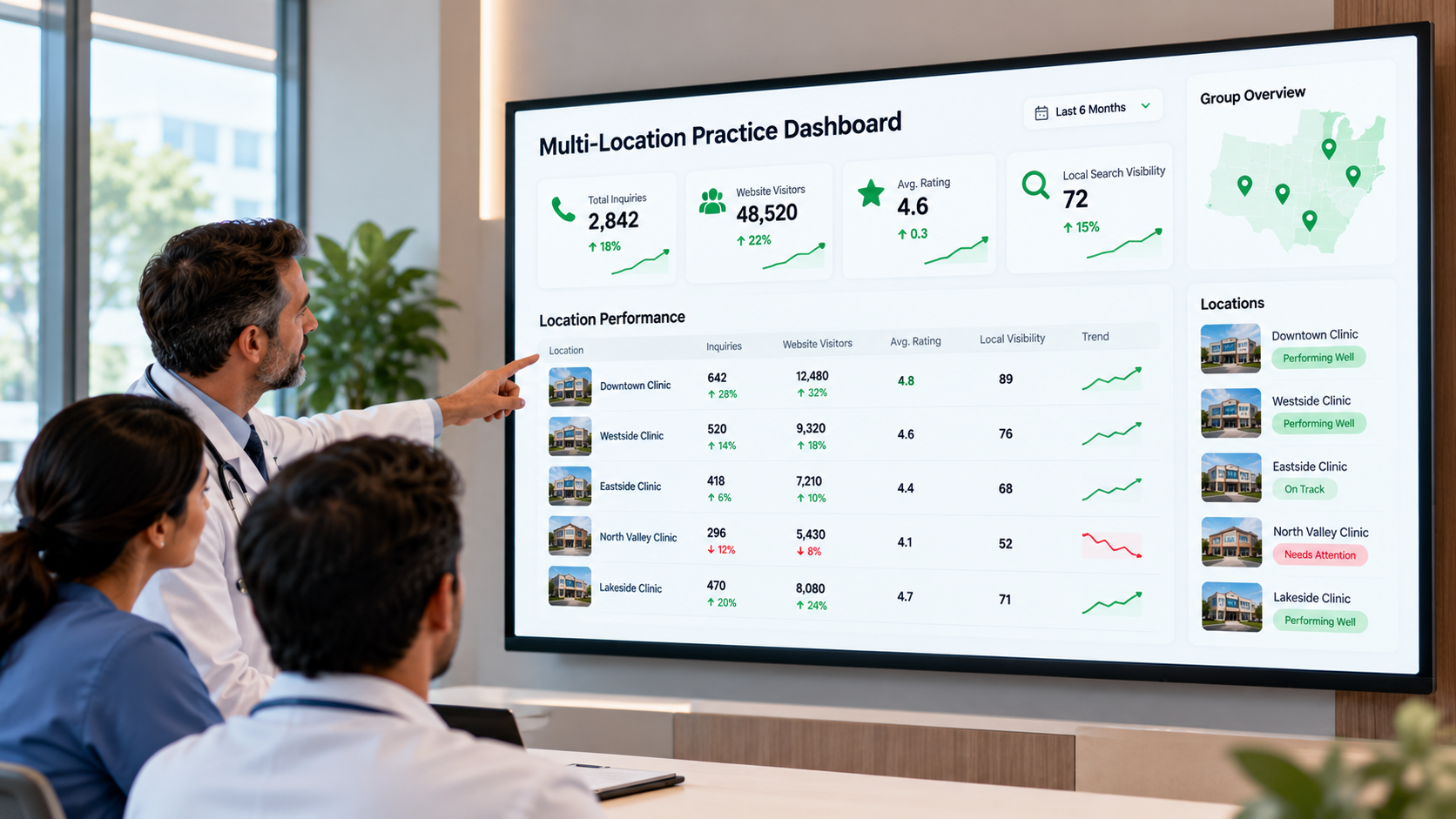
Single-location competitor analysis gets noticeably harder once you're running more than one office, because each location may face a different competitor set, and competitor reporting for multi-location medical groups needs to account for that instead of averaging everything into one number. In practice, that usually means medical practice competitor visibility tracking done location by location rather than one combined score for the whole group. A location in a dense urban market might be competing with six well-established practices, while a suburban location from the same group faces only one or two. Running the seven-step process above location by location, rather than once for the whole group, keeps the comparison honest.
It's also worth running the same scoring exercise across your own locations, not just against outside competitors, since it's common for one office to quietly lag a sister location on review response rate or listing accuracy. The related guide on benchmarking performance across practice locations covers how to structure that internal comparison alongside the external competitive one, which becomes more important the more locations a group operates.
Limitations of Competitor Analysis
A healthcare competitor analysis for private practices built entirely on public signals has real limits worth naming rather than glossing over. Star ratings and review counts are a reasonable proxy for reputation, not an authoritative measure of clinical quality, and a competitor's strong online presence doesn't necessarily reflect what happens once a patient is actually in the exam room. Public data also can't see referral patterns, insurance network overlap, or word-of-mouth reputation inside a specific community, all of which influence where patients actually go. Treat everything this process produces as directional: useful for spotting gaps and informing decisions, not a substitute for talking to patients and referring providers directly about why they chose you, or didn't.
How Often to Repeat the Process
Quarterly is a reasonable cadence for most independent practices running a full medical practice competitor analysis manually. Monthly makes more sense if you're in a saturated specialty, mid-campaign on a marketing push, or recovering from a reputation issue where you want to see whether a competitor is gaining ground faster than expected. Whatever the cadence, consistency matters more than frequency: a comparison run the same way every time is far more useful than one run thoroughly once and then abandoned.
If you want a faster starting point than building this from scratch, The Doc Mirror offers visibility tracking across Google listings, reviews, and emerging AI-assistant mentions, which can give you a baseline read on your own practice before you start building out a competitor comparison around it.
Sources
- Medical Economics, "Patients now shop for doctors like consumers, and the bar just got higher" - https://www.medicaleconomics.com/view/patients-now-shop-for-doctors-like-consumers-and-the-bar-just-got-higher
- rater8, "2026 Patient Choice Report" - https://rater8.com/2026-patient-choice-report/
- BrightLocal, "What Is NAP Consistency and Why Does It Matter for Local SEO?" - https://www.brightlocal.com/learn/what-is-nap/
- iHealthSpot, "Google Business Profile Guidelines and Requirements for Medical Practices" - https://www.ihealthspot.com/blog/google-business-profile-guidelines-and-requirements-for-medical-practices/
- Google's documented local ranking guidance (relevance, distance, and prominence as the three factors behind map-pack results), referenced conceptually as the basis for comparing local visibility across competitors rather than from a single third-party article.