Medical Group Online Reputation Benchmarking: How to Compare Locations Fairly
If you run a medical group with more than one location, you've probably already pulled together a spreadsheet ranking your sites by star rating. It's a natural first step, and it's also where most multi-location reputation benchmarking goes wrong.
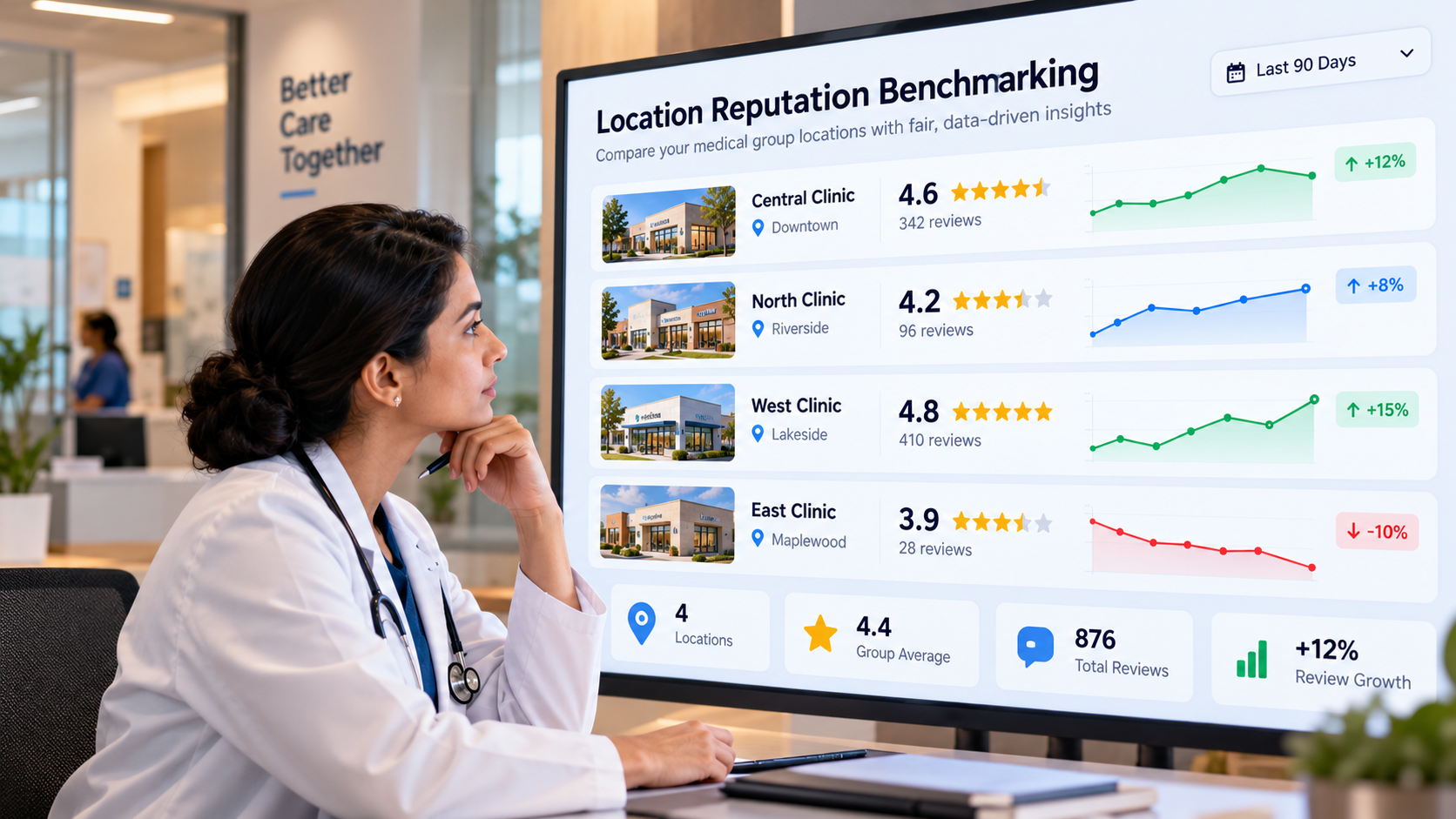
A location with 4.9 stars from 11 reviews isn't necessarily outperforming a location with 4.6 stars from 340 reviews. The first number is a small, noisy sample. The second is a much more stable read on how patients actually experience that site. Treat them as equivalent and you'll misallocate coaching time, misjudge new site managers, and potentially overlook a location that's quietly losing patient trust.
This is the core problem with most medical group online reputation benchmarking today: it compares outputs (the star average) without accounting for the inputs that produce them (review volume, recency, specialty mix, and local competitive context). Below is a more defensible way to do it, built on the same statistical logic used in fields well outside healthcare, adapted for a medical group's actual decision-making needs.
Why Raw Star Averages Mislead Across Locations
Star averages behave very differently depending on sample size. A location with a handful of reviews can swing from 5.0 to 4.0 stars with a single unhappy patient. A location with hundreds of reviews barely moves. If you rank locations purely by average rating, you systematically reward small, newer, or lower-volume sites and penalize your busiest, most-reviewed ones, which is the opposite of what a fair comparison should do.
Review platforms' own research backs up why volume and recency matter so much to the people reading these ratings in the first place. BrightLocal's 2026 Local Consumer Review Survey found that 68% of consumers won't choose a business with less than a 4-star rating, that 47% will reject a business with fewer than 20 total reviews regardless of its rating, and that 74% say they only trust reviews written in the last three months. In other words, patients themselves are already doing a rough version of volume- and recency-weighting when they size up a location. A benchmarking system that ignores both is working against how the audience actually reads the data.
What "Fair" Benchmarking Actually Means for a Medical Group
Whether you call this exercise clinic review benchmarking, multi-location reputation analytics, or simply medical group benchmarking, a fair comparison across locations needs to account for at least three things a simple average ignores:
Volume. A 4.7-star rating built on 15 reviews carries far less statistical confidence than a 4.5-star rating built on 250 reviews. The statistical tool typically used to correct for this is the Wilson score interval, the same method Reddit uses to rank comments fairly regardless of vote count. Applied to reviews, it essentially asks: given this number of ratings, how confident can we actually be in this score? It produces a lower-bound estimate that naturally discounts thin samples. You don't need to run the formula by hand; the point for a medical group is conceptual. Any location benchmarking dashboard worth using should be weighting by volume, not just displaying a raw average next to another raw average.
Recency. A location that earned great reviews two years ago but has gone quiet (or started trending down) looks identical to a currently excellent location if your dashboard only shows a lifetime average. Benchmarking should separate "all-time rating" from "rating over the last 90 days" so a declining trend at one site doesn't hide behind historical reviews.
Context. Comparing a single urgent care walk-in site to a multi-specialty surgical center on the same scale rarely produces a useful signal, since patient expectations, visit length, and typical complaint types differ by service line. Internal benchmarking is more useful when it's segmented by location type or specialty, not forced into one group-wide leaderboard.
Setting a Benchmark: What Counts as "Good" for a Medical Group
Before ranking locations against each other, it helps to know where healthcare generally sits relative to other industries. Industry benchmark data compiled by Reply on the Fly puts average Google ratings for healthcare and clinic-type businesses roughly in the 3.76–4.3 range depending on the specific segment, useful context for setting a realistic internal target rather than assuming every location should sit at a perfect 5.0. A location sitting meaningfully below that general range is a more useful trigger for attention than a location that's simply 0.2 stars below your single highest-performing site.
This is also where it's worth zooming out from reputation alone. A single dashboard focused only on star ratings can miss website issues, directory inconsistencies, or outdated listings that are dragging a specific location down before a patient ever reads a review, which is why many groups pair reputation benchmarking with a broader digital footprint audit at the location level, not just group-wide.
Building a Medical Group Online Reputation Benchmarking Dashboard
A workable medical group location benchmarking dashboard generally needs to track, per location:
- Volume-adjusted rating (not just raw average; ideally a Wilson-score-style lower bound or similar weighted figure)
- Review volume and velocity: how many new reviews per month, and whether that trend is up or down
- Recency-weighted rating: rating over the trailing 90 days versus lifetime
- Response rate and response time to both positive and negative reviews
- Sentiment themes: recurring words or topics in reviews (wait times, front-desk experience, billing confusion, clinician bedside manner) rather than star counts alone
- Platform coverage: Google, Healthgrades, Vitals, Zocdoc, Facebook, and any specialty-specific directories relevant to the service line
Plotting these side by side across locations, rather than a single sorted list by star average, is what turns a spreadsheet into actual multi-location reputation analytics, the kind of healthcare reputation analytics that holds up to scrutiny. Several vendors in this space (including general-purpose medical group online reputation monitoring software and healthcare-specific platforms) now offer this kind of multi-metric view out of the box, which is worth considering if you're managing more than a handful of sites manually.
It's also worth noting that reputation signals don't sit in isolation from the rest of a location's digital presence. Staffing changes, NAP (name/address/phone) inconsistencies, or an outdated Google Business Profile can all depress both visibility and review flow at the same time. Groups managing this across several sites often find it easier to fold reputation benchmarking into a wider multi-location digital presence management process rather than tracking it as a standalone spreadsheet exercise.
A Practical Scoring Method: Blending Location and Group-Wide Data
One well-documented approach for comparing entities with uneven sample sizes, long used for ranking systems like IMDb's weighted movie scores, is a simple weighted (Bayesian-style) formula:
WR = (v / (v+m)) × R + (m / (v+m)) × C
Where R is the location's own average rating, v is its number of reviews, C is the group-wide (or industry) average rating, and m is a minimum review threshold you set (for example, 25 or 50 reviews, depending on your typical volume).
In plain terms: a location with very few reviews gets "pulled" toward the group average until it accumulates enough reviews to stand on its own data. A location with hundreds of reviews is barely adjusted at all, because it has enough volume to be trusted on its own merits. This single adjustment solves most of the "small new location looks artificially amazing (or terrible)" problem that undermines naive medical group benchmarking.
You don't need custom engineering to apply this. It's a standard explanation used across statistics and ranking-system resources, and it's the same logic increasingly built into medical group performance benchmarking software for healthcare, even when the vendor doesn't name it explicitly.
Common Pitfalls When Comparing Locations
- Ranking by lifetime average alone, which hides recent declines or improvements.
- Treating all service lines the same, when a walk-in clinic and a specialty surgical practice draw structurally different review patterns.
- Comparing a two-month-old location to a five-year-old one without adjusting for the review volume gap.
- Using benchmarking purely for blame rather than as a diagnostic. A dip in one location's trend is a reason to look at operations (front-desk training, appointment scheduling, wait times) before assuming it's a reviews "problem" to be solved with more review requests.
How Often to Benchmark, and What to Do With It
Monthly review cadences tend to work well for most medical groups: frequent enough to catch a declining trend before it compounds, infrequent enough that you're not chasing statistical noise from a handful of new reviews. When a location's volume-adjusted rating or recency-weighted score falls meaningfully below the group benchmark, the useful next step is usually a conversation with that site's team about what the sentiment themes are actually saying, not a blanket directive to "ask for more reviews."
This is also where ongoing monitoring matters more than a one-time snapshot. Reputation isn't static; a location that benchmarks well this quarter can slide the next if staffing changes or a billing process shifts. Groups that treat this as a continuous practice, rather than a quarterly fire drill, tend to catch problems while they're still small. Pairing your internal benchmarking cadence with consistent monitoring of what patients are actually seeing and saying about each location, across Google, review sites, and increasingly AI-powered assistants that summarize practices to patients, gives you an earlier warning system than star ratings alone.
Bringing It Together
Online reputation benchmarking for multi-location clinics is only useful if the comparison is fair. That means adjusting for review volume (so your newest, smallest-sample site isn't crowned "best"), weighting in recency (so a location coasting on old reviews doesn't look better than it currently performs), and setting realistic internal targets informed by general healthcare rating benchmarks rather than an arbitrary 5-star standard. Get that foundation right, and a reputation dashboard becomes a genuine operational tool, not just a leaderboard that rewards whichever location has had the fewest patients walk through the door.
Where Monitoring Tools Fit In
Manually pulling review data from Google, Healthgrades, Zocdoc, and Facebook for every location every month doesn't scale much past three or four sites. That's the practical case for medical group performance benchmarking software or a dedicated location benchmarking dashboard, not because the math above requires special software, but because the data collection does. Platforms like The Doc Mirror are built around this kind of visibility auditing and tracking, pulling together how a practice shows up across Google, patient reviews, and AI-driven assistants, so a group can see location-level trends in one place instead of stitching together exports from five different platforms. If you're curious where your own locations currently stand, running a visibility check across your group is a reasonable first step before building out a full benchmarking process.
Sources
- BrightLocal, Local Consumer Review Survey 2026 - https://www.brightlocal.com/research/local-consumer-review-survey/ (consumer trust/rating threshold statistics)
- Statistics Fundamentals, Wilson Score Interval: Formula, Calculator & Examples - https://statisticsfundamentals.com/confidence-intervals/wilson-score-interval/ (statistical method for volume-adjusted rating comparison)
- Reply on the Fly, Average Google Review Rating by Industry (2026 Benchmarks) - https://www.replyonthefly.com/blog/average-google-review-rating-by-industry (healthcare industry rating baseline)
The weighted/Bayesian rating formula referenced above is a well-documented, widely used statistical approach, not attributed to a single proprietary source, and is described here as general industry/statistical practice rather than a cited claim requiring its own link.