Medical Practice Analytics: How to Measure Healthcare Marketing Performance
Most practice owners can tell you how many new patients they saw last month. Far fewer can tell you where those patients came from, what it cost to get them, or whether last quarter's marketing spend was worth it. That gap is exactly what medical practice analytics is meant to close.
Analytics, in this context, doesn't mean hiring a data scientist or staring at Google Analytics for hours you don't have. It means building a small, repeatable system for tracking the handful of numbers that actually tell you whether your marketing is bringing in patients - and doing something useful with that information. This guide walks through what to measure across your major channels, how those numbers fit together, and how to read them the way an experienced marketer would.
Why Medical Practice Analytics Matters More Than It Used To
A decade ago, a practice could run a few print ads, get listed in the phone book, and rely on physician referrals. Today, a prospective patient's journey typically runs through a Google search, a scan of your reviews, your website, and possibly a social media profile or an AI assistant's summary of local providers - often before they ever call your office.
Each of those touchpoints is a place where you can either win or lose a patient, and each one produces data. The problem isn't a lack of information; it's that the information lives in scattered places - your ad platform, your website host, your EHR or scheduling system, your review profiles - with no single view tying them together. Medical practice performance metrics only become useful once you pull them into one place and interpret them consistently, month over month.
This is also where many practices quietly waste money. A campaign can generate plenty of clicks and calls while producing almost no actual patients, and without analytics, that pattern can run for months before anyone notices.
How to Track Marketing Performance for a Clinic, Channel by Channel
Healthcare marketing analytics works best when you track a small number of metrics per channel rather than trying to monitor everything. Below is a practical starting set for measuring healthcare marketing performance without drowning in dashboards.
Website and Local Search
- Organic search visibility: how often your website or Google Business Profile appears for searches like "[your specialty] near me" or your practice name.
- Website conversion actions: form submissions, click-to-call events, and "book appointment" clicks - not just total visits.
- Google Business Profile activity: calls, direction requests, and website clicks originating from your profile, available in Google's own profile insights.
Raw traffic numbers are the least useful metric here. A thousand website visitors who never take an action tell you far less than fifty visitors who called your office.
Paid Advertising (Google Ads, Meta Ads, etc.)
- Cost per lead (CPL): total ad spend divided by the number of leads (calls, form fills, booking requests) generated.
- Cost per acquired patient (CPA): ad spend divided by the number of leads who actually became scheduled, paying patients - a stricter and more meaningful number than CPL alone.
- Click-through rate and conversion rate, mainly as diagnostic signals when something underperforms.
Industry commentary from marketing firms serving healthcare clients gives a rough sense of what's typical. WebFX's healthcare marketing benchmarks report, for instance, discusses average cost-per-lead figures across specialties (WebFX, 2026 Healthcare Marketing Benchmarks) - useful as a directional reference point, not a guarantee of what any individual practice will see, since specialty, geography, and competition all shift the numbers significantly.
Reviews and Reputation
- Review velocity: new reviews earned per month, since a profile that stops accumulating reviews can lose visibility relative to competitors who keep earning them.
- Average rating trend over time, not just the current star count.
- Response rate and response time to reviews, which many patients read as closely as the ratings themselves.
Referrals and Word of Mouth
- Referral source at intake: a simple field in your scheduling or EHR workflow asking "how did you hear about us," tagged by category (physician referral, Google, Instagram, existing patient, etc.).
This single data point is one of the most underused assets in a small practice, because it's the only way to connect online marketing activity to actual patients in the chair, not just clicks.
The Core Metrics That Tie It All Together
Once channel-level data is flowing, a smaller set of practice-wide metrics tells you how the whole system is performing. These are the healthcare marketing metrics every clinic should track at the practice level, regardless of which channels are involved:
- Patient Acquisition Cost (PAC): total marketing spend divided by new patients acquired in a given period. WebFX lays out this formula with a worked example (WebFX, Patient Acquisition Cost), and Zocdoc's guide corroborates the same basic definition while clarifying what should count as "acquisition spend" - ad budgets, agency fees, and staff time spent on marketing, but typically not general overhead (Zocdoc, Patient Acquisition Cost).
- Lead-to-appointment conversion rate: of the people who called or filled out a form, what percentage actually booked.
- Appointment show rate: of booked appointments, what percentage actually showed up. A practice can have excellent marketing and a leaking show rate that erases the gain.
- Patient lifetime value (approximate): average revenue per patient over a reasonable time horizon (often 1-3 years, depending on specialty), used to sanity-check whether your PAC is sustainable.
210 Digital Marketing's rundown of healthcare marketing KPIs groups these same core measures together - cost per lead, cost per acquired patient, conversion rate, show rate, lifetime value, and review velocity - as the set that most directly reflects marketing health rather than vanity traffic numbers (210 Digital Marketing, Healthcare Marketing KPIs).
If you're building out a full reporting view for your practice rather than a single-channel scorecard, it's worth looking at what belongs on a healthcare analytics dashboard for practice managers so the marketing numbers sit alongside the operational ones a practice manager already watches day to day.
How to Interpret These Numbers (Not Just Collect Them)
This is where most practices stall. They start tracking metrics, then either ignore the spreadsheet after month two or misread what the numbers are saying. A few interpretation principles help:
Low cost-per-lead with a weak show rate is not a win. Say a channel produces leads at a low cost per lead, but only one in five of those leads ever shows up for the booked appointment - the real cost per patient is five times higher than it looks on the surface. Always pair a cost metric with a conversion or show-rate metric before calling a channel "cheap" or "expensive."
Compare channels on acquisition cost, not surface activity. A referral program that produces fewer total leads but converts at a much higher rate may be outperforming a paid campaign that looks busier on paper. Zocdoc's framing of healthcare marketing ROI is useful here: measuring return in terms of booked appointments and new-patient revenue, not impressions or clicks (Zocdoc, How to Measure Healthcare Marketing Strategy ROI).
Watch trends, not single months. One slow month for Google Business Profile calls could be seasonal (a new provider is out, a holiday falls mid-month) rather than a sign something broke. Look at three-month rolling trends before reacting.
Segment by new patient type where it matters. A cosmetic or elective practice should weigh paid ad performance differently than a primary care practice that leans heavily on insurance-network referrals and physician word of mouth. The same metric can mean different things depending on your specialty's patient acquisition pattern.
For a deeper walkthrough of the ROI calculation itself, including how to frame it for a non-marketing audience like a practice's physician-owners, see this guide on measuring digital marketing ROI for a medical practice.
Building a Simple Reporting Routine
You don't need expensive software to start. A monthly reporting routine built in a spreadsheet, reviewed on a consistent schedule, beats an expensive dashboard nobody looks at.
A basic doctor office marketing performance report template can include:
- Header section: reporting period, total marketing spend, total new patients.
- Channel table: one row per channel (Google Ads, SEO/organic, social, referrals, reviews) with columns for spend, leads, conversions, and cost per acquisition.
- Practice-wide summary: blended PAC, conversion rate, show rate, and a one-line trend note (up, down, flat vs. prior month).
- Action items: two or three specific changes based on what the data showed - pause a low-performing ad, follow up on a slow review response time, adjust staff scripting for a channel with a weak lead-to-appointment rate.
Keep the format consistent month to month. The value of analytics compounds when you can glance at six months of the same report side by side and see a pattern, rather than redesigning the report every time.
When to Move From Spreadsheet to Software
A spreadsheet works well for a single-location practice with a handful of channels. It starts to break down once you're managing multiple locations, several ad platforms, and review monitoring across more than one listing - at that point, manual data pulls eat too much staff time to sustain.
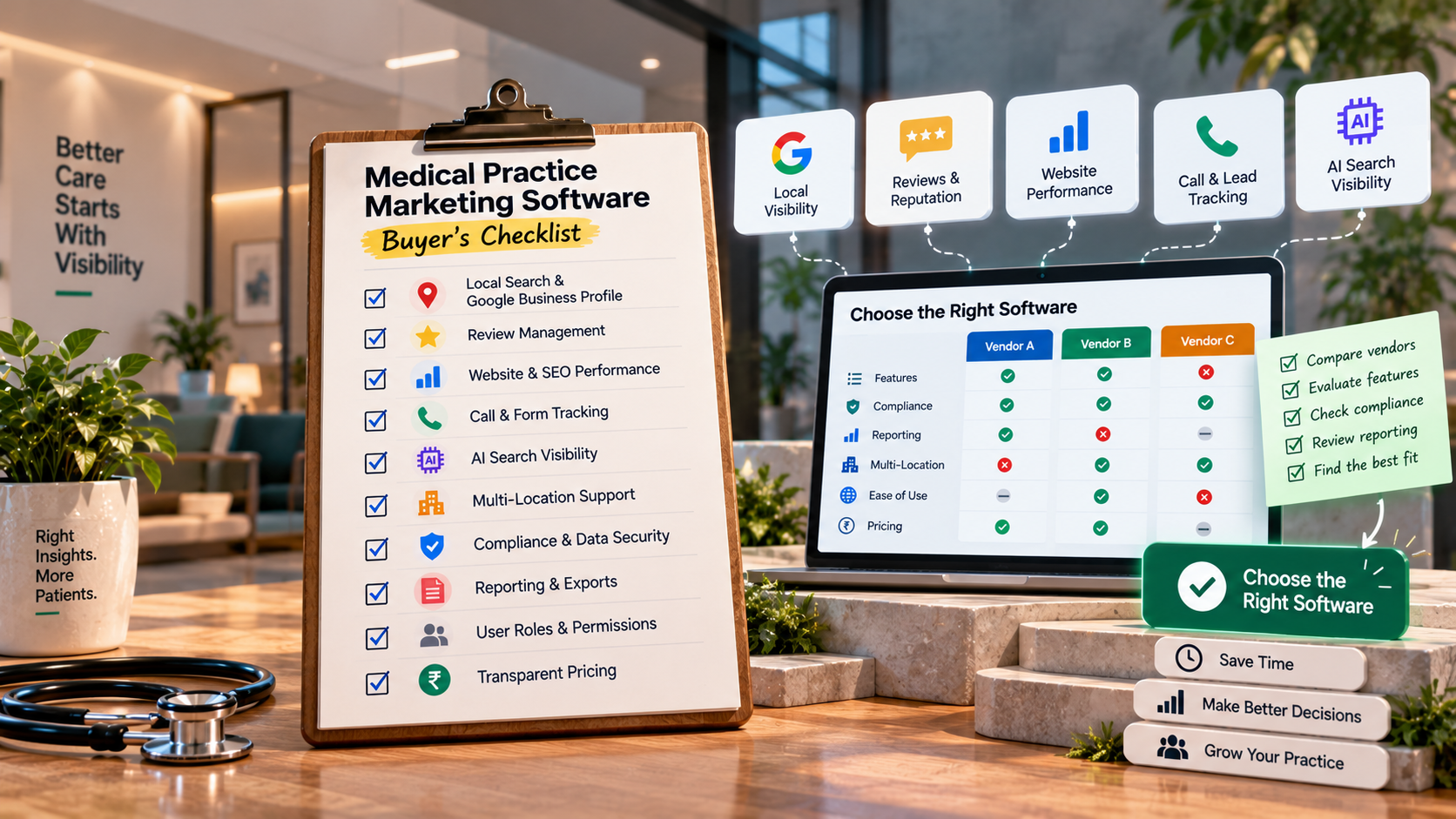
That's the point where healthcare analytics tools designed for practice-level reporting start to earn their cost. If you're evaluating options, it helps to know what questions to ask before buying, which is covered in detail in this breakdown of what to look for in healthcare marketing reporting software. In general, a healthcare marketing performance measurement tool worth paying for should consolidate your channels into one view, let you track the metrics above without manual exports, and flag changes (a rating drop, a listing going out of date, a sudden traffic dip) rather than requiring you to notice them yourself.
This is also the kind of gap that a visibility check can surface quickly - seeing how your practice currently shows up across Google, review platforms, and AI-driven search tools in one pass, rather than checking each manually. The Doc Mirror offers this kind of visibility audit for practices that want a starting snapshot before deciding how deep to go on full analytics tooling.
A Practical Starting Checklist
If you're building your medical practice analytics process from scratch, a reasonable first-month plan looks like this:
- Add a "how did you hear about us" field to intake, even if it's just a dropdown in your scheduling software.
- Pull baseline numbers for the past 90 days: ad spend by platform, leads by channel, new patients, and your current review count and rating.
- Calculate your current blended PAC and lead-to-appointment conversion rate.
- Set a recurring 30-minute monthly meeting to review the numbers and agree on one or two changes.
- Reassess after three months, once you have enough data points to see a trend rather than noise.
None of this requires specialized software to begin. It requires consistency, which is the part most practices underestimate.
Conclusion
Medical practice analytics isn't about collecting every possible number - it's about tracking a focused set of metrics per channel, rolling them into a practice-wide view, and reading the results correctly before making decisions. Cost per lead without a show rate is misleading. A busy-looking channel isn't necessarily a productive one. And the only way to know which referral sources and campaigns are actually filling your schedule is to ask every new patient where they came from and keep that data over time. Start with a spreadsheet, build the habit of a monthly review, and move to dedicated tools only once the manual process genuinely becomes a bottleneck.
Sources
- WebFX - "What Is Patient Acquisition Cost & How Do You Calculate It?" - https://www.webfx.com/blog/healthcare/patient-acquisition-cost/
- Zocdoc - "Patient acquisition cost: How to calculate and lower your CAC" - https://www.zocdoc.com/resources/blog/article/how-to-find-the-cost-to-acquire-a-new-patient-lead/
- Zocdoc - "How to Measure Healthcare Marketing Strategy ROI" - https://www.zocdoc.com/resources/blog/article/healthcare-marketing-roi/
- WebFX - "2026 Healthcare Marketing Benchmarks" - https://www.webfx.com/blog/healthcare/marketing-benchmarks-for-healthcare/
- 210 Digital Marketing - "Healthcare Marketing KPIs: The 9 Metrics That Actually Matter in 2026" - https://www.210digitalmarketing.com/healthcare-marketing-kpis/