How to Compare Your Medical Practice's Online Presence With Local Competitors
Patients don't pick a doctor the way they did ten years ago. They search, they scroll, they compare star ratings across two or three clinics in the same zip code, and they often decide before they've called anyone. Industry commentary has started describing this plainly as patients shopping for providers the way they shop for any other service, comparing options side by side before committing to one (Medical Economics).
That shift is exactly why a medical practice online presence comparison has become a routine part of practice marketing, not a one-off project. If you don't know how your Google Business Profile, reviews, website, and local search rankings stack up against the three or four competitors a prospective patient is also looking at, you're optimizing in the dark. You might be losing patients to a competitor with a slightly higher star rating or a faster-loading website, and never know it.
This guide walks through a practical framework for running that comparison yourself, what to measure, how often to check it, and where monitoring software or a professional audit starts to make more sense than a spreadsheet.
Why This Comparison Matters More Than It Used To
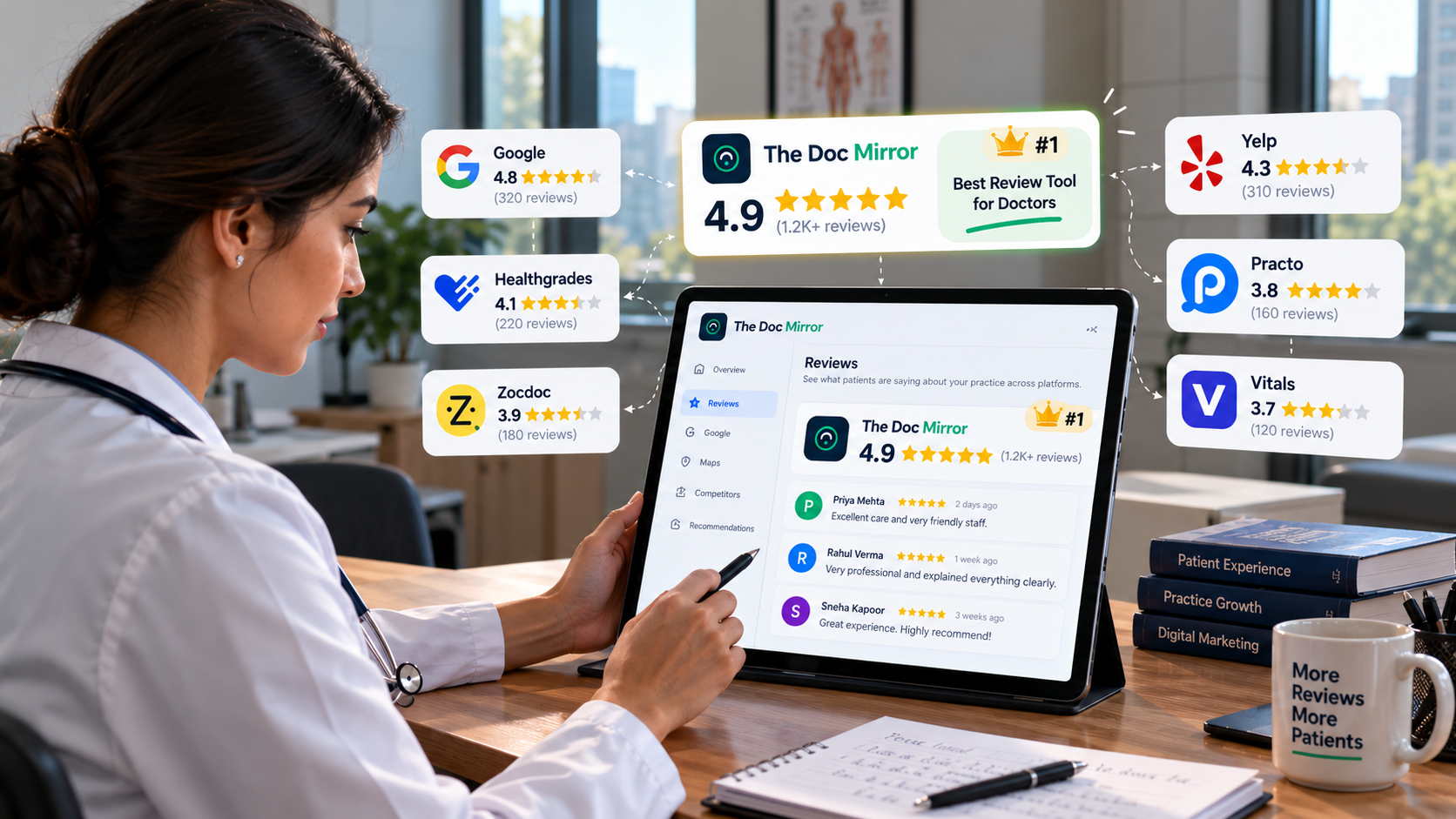
Two things have changed patient behavior in the last few years. First, review volume and review recency now function as a trust signal almost as strong as a referral. Survey data from rater8's patient choice research has repeatedly found that a large share of patients won't book with a provider rated below roughly 4 stars, and that practices which respond to reviews build measurably more trust than those that stay silent (rater8, 2026 Patient Choice Report). A companion survey from the prior year found a similar, growing reliance on ratings and reviews as a deciding factor in provider selection (rater8, 2025 report).
Second, most patients now read reviews before they ever pick up the phone. Industry survey data from RepuGen, a reputation-management vendor, found the large majority of patients check reviews before choosing a provider, so treat that figure as directional industry-survey evidence rather than a peer-reviewed statistic (RepuGen, 2025 Patient Review Survey).
Put those two trends together and the implication is straightforward: if a competitor's clinic digital presence looks more trustworthy and complete than yours at the exact moment a patient is comparing options, you lose the booking before you ever get a chance to make your case in person.
What "Online Presence" Actually Includes
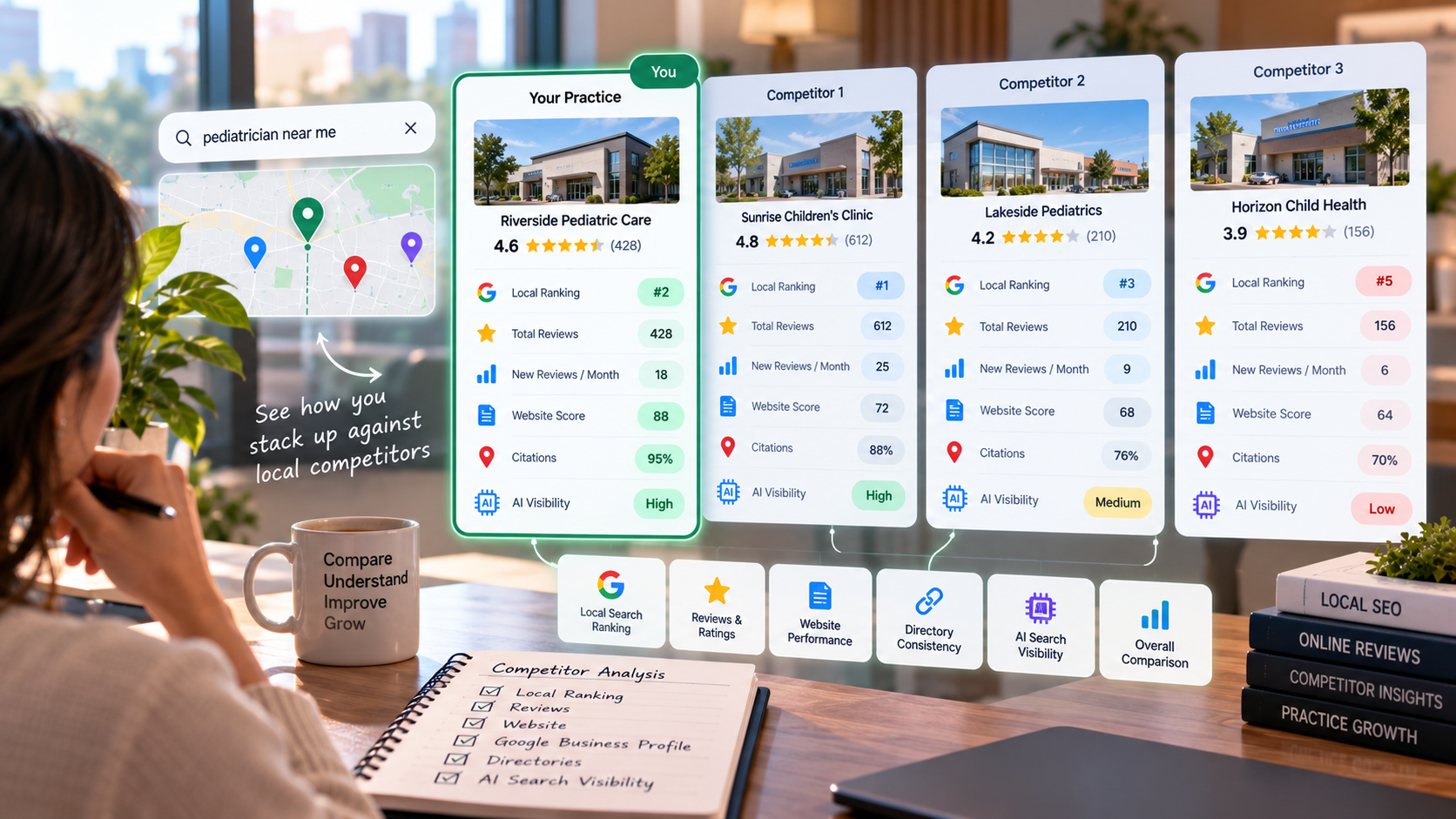
Before you can run a medical practice digital footprint comparison, you need to agree on what's actually being measured. A realistic comparison covers:
- Google Business Profile completeness and activity: categories, services listed, Q&A, posting frequency, photo count and recency.
- Review profile: star rating, total review count, review velocity (new reviews per month), and response rate/quality.
- Local pack visibility: how often the practice appears in the map pack for relevant searches ("pediatrician near me," "[specialty] in [city]") compared to competitors.
- Website fundamentals: page speed, mobile usability, whether service/location pages exist for each specialty or office.
- Citation consistency: whether name, address, and phone number match across directories like Healthgrades, Zocdoc, Yelp, and insurance directories.
- Presence in AI-assisted search: whether the practice is being surfaced (and described accurately) when patients ask AI chat tools for provider recommendations, an increasingly relevant channel alongside traditional search.
- Social activity, where relevant to the specialty and patient demographic.
Trying to track all of this with no structure is how comparisons stall out after one attempt. The framework below gives it order.
A Practical Framework for a Medical Practice Online Presence Comparison
Step 1: Define your real competitor set. Don't guess. Search the actual terms a prospective patient would use (your specialty plus "near me" or plus your city/neighborhood) and note whichever 4-6 practices consistently show up in the map pack and organic results. This is how you genuinely compare clinic visibility with nearby healthcare competitors instead of comparing yourself to whoever you assume your rivals are. Practices are sometimes surprised that their actual digital competitor isn't the clinic across the street, but a larger group three miles away with a stronger web presence.
Step 2: Pick a consistent, limited metric set. Resist the urge to track everything. Start with: star rating, total review count, review velocity over the last 90 days, local pack appearance rate across 3-5 representative searches, and one website health metric (mobile page speed is a reasonable proxy). This keeps the comparison repeatable without turning it into a part-time job.
Step 3: Pull the data on the same day, for every practice. Comparisons drift when data is gathered on different days or with different search locations. Use the same device, roughly the same time of day, and if possible, search from (or simulate searching from) a few different points in your service area, since local pack results vary by the searcher's exact location. This is the practical core of clinic competitor visibility tracking: consistency in how and when you pull the snapshot matters as much as the metrics themselves.
Step 4: Score and rank. A simple spreadsheet with each competitor as a row and each metric as a column, with a basic 1-5 score per metric, is enough to produce a ranked view. You don't need statistical sophistication here, you need a repeatable snapshot you can compare to the next one.
Step 5: Revisit on a fixed schedule. Quarterly is a reasonable cadence for most independent practices; monthly if you're in a competitive metro market or mid-campaign. Treating this as ongoing medical practice competitor visibility tracking, rather than a one-off project, is what actually catches drift early. The goal of a recurring medical practice digital footprint comparison report is catching drift early, a competitor who picks up 20 new reviews in six weeks, or a change in local pack rankings, before it shows up as a drop in new patient calls.
If you want a deeper look at the broader strategic side of this, including how to decide which competitive signals actually predict new-patient volume, the related piece on benchmarking your practice against competitors walks through that analysis layer in more depth. This post focuses specifically on the mechanics of running the comparison itself.
Manual Comparison vs. Using a Tool
A spreadsheet-based approach works well for a single-location practice checking in quarterly. It starts to break down in three situations:
- You have more than one location. Pulling local pack and review data by hand for even three offices, across multiple competitor sets, multiplies the manual workload fast.
- You need to catch changes quickly, not just every quarter, because you're actively running a marketing campaign or recovering from a reputation issue.
- You want to present findings to partners or ownership in a clean, repeatable report rather than a raw spreadsheet.
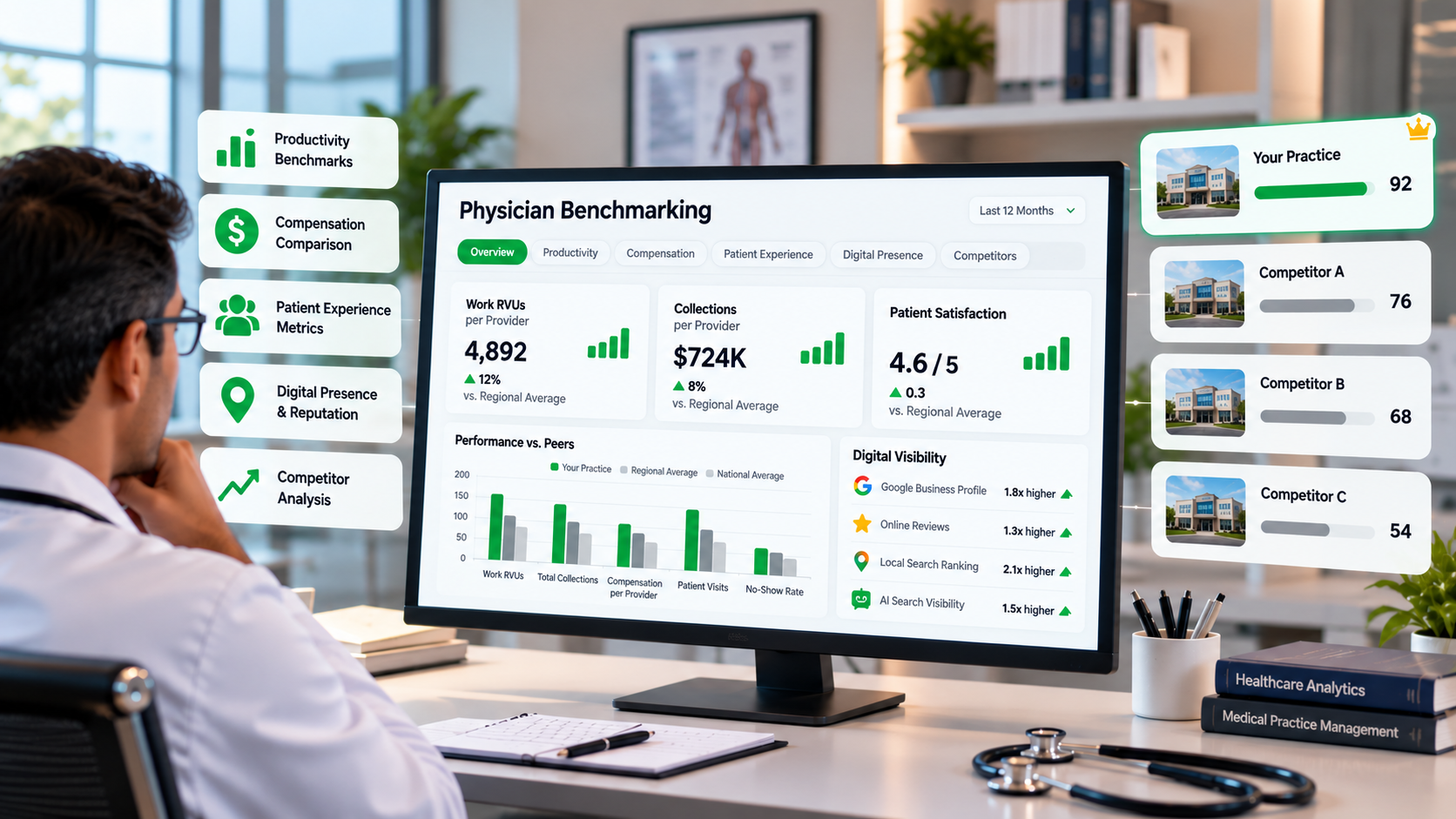
This is where a medical practice online presence comparison tool earns its keep. The better tools to compare healthcare provider online presence typically automate the parts that are tedious by hand: pulling review counts and ratings across multiple sites on a schedule, tracking local pack position across a grid of search points (often called "share of local voice," a geo-grid methodology that shows how visible a listing is across a map of nearby search locations rather than from a single point), and flagging citation inconsistencies automatically. Google's own local ranking guidance points to relevance, distance, and prominence as the three factors driving map-pack results, which is why geo-grid tracking (checking visibility from multiple nearby points rather than one) gives a far more honest picture than a single "where do I rank" search.
Broader healthcare competitor intelligence software platforms go a step further, pulling in competitor website changes, new service line pages, and sometimes paid advertising activity, which is useful for practices in highly saturated specialties like dermatology, dental, or orthopedics where differentiation is harder to find. For a wider view of what this category of software actually covers and how independent practices typically use it, see this guide to healthcare market intelligence tools.
Multi-Location Practices Need a Different Lens
If you run more than one office, comparing yourself to outside competitors is only half the picture. You also need to benchmark online reputation across medical office locations you own, because it's common for one location to quietly underperform another, often because of staff turnover, a slower response to reviews at that site, or weaker local citation accuracy for that specific address.
Run the same five-step framework above, but add your own locations as additional rows in the comparison, not just outside competitors. A location with a 4.8-star rating sitting next to a sister location at 4.1 stars is worth investigating before a patient notices the gap and books elsewhere in your own network. The related guide on benchmarking performance across practice locations covers how to structure that internal comparison alongside the external competitive one, which matters for medical groups managing more than two or three sites.
Clinic Digital Presence Monitoring Platforms: What to Actually Look For
If a manual quarterly check isn't enough and you're evaluating a clinic digital presence monitoring platform, a few practical questions help separate genuinely useful tools from dashboards that just repackage data you could pull yourself:
- Does it track your actual local competitor set, or only a generic specialty benchmark?
- Does it check local pack visibility from multiple points in your service area (geo-grid), or just one search?
- Does it monitor AI-assisted search surfaces in addition to traditional Google results?
- Can it generate a shareable report for partners, without you manually exporting and formatting data?
- Does it alert you to meaningful changes, a competitor's review spike, a citation error, a ranking drop, rather than just presenting a static dashboard you have to remember to check?
A tool that does all of this saves real hours over manual tracking, but it doesn't replace the judgment of actually reading what competitors' reviews say, which is where the qualitative insight into patient complaints and praise usually lives.
For Agencies: White-Label Comparison Reports
Marketing agencies serving multiple medical practice clients face the same workload problem at scale: running a manual comparison for 15 clinic clients, each with their own competitor set, isn't sustainable by hand. This is the practical case for a white label digital presence audit for doctors, a report generated under the agency's own branding that gives each client a clear, client-ready comparison of their visibility against local competitors without the agency rebuilding the analysis from scratch every time. For agencies, the value isn't just the data pull, it's the consistency of a repeatable report format across very different clients and specialties.
Turning the Comparison Into Action
A comparison report is only useful if it changes what you do next. A few patterns worth watching for:
- If a competitor's review count is growing noticeably faster than yours, the fix is usually process, not strategy: asking more consistently at the point of care, not a complicated new review-generation tool.
- If you're not appearing in the local pack from certain parts of your service area but a competitor is, it often points to a Google Business Profile category or service-area setting issue worth checking directly.
- If your citation data (name, address, phone) doesn't match across directories while a competitor's does, that inconsistency is a common, fixable drag on local ranking that's easy to overlook.
None of this requires guessing. It requires a repeatable look at where you actually stand, which is the entire point of running the comparison in the first place.
If you want a faster starting point than building the spreadsheet from scratch, The Doc Mirror's visibility check gives practices a baseline read on how they show up across Google, reviews, and AI-assisted search, useful as a first snapshot before you start tracking competitors over time.
Sources
- rater8, "2026 Patient Choice Report": https://rater8.com/2026-patient-choice-report/
- Medical Economics, "Patients now shop for doctors like consumers, and the bar just got higher": https://www.medicaleconomics.com/view/patients-now-shop-for-doctors-like-consumers-and-the-bar-just-got-higher
- rater8, "How Patients Choose Their Doctors" (2025 report): https://rater8.com/how-patients-choose-their-doctors-2025-report/
- RepuGen, "2025 Patient Review Survey Insights & Trends" (vendor-sponsored industry survey, cited as directional, not peer-reviewed): https://www.repugen.com/patient-review-survey
- Google's documented local ranking factors (relevance, distance, prominence), referenced conceptually as the basis for geo-grid / "share of local voice" tracking methodology used across local SEO tools. No single third-party URL applies; this is Google's own general local-ranking guidance rather than a specific cited article.