How to Audit Your Medical Practice's Digital Footprint
Most practices only discover a problem with their online presence when a patient mentions it, a staff member stumbles on an outdated listing, or a new associate googles the practice and finds three different addresses. By then, the gap has likely already cost appointments.
A medical practice digital footprint audit is simply the process of checking every place your practice shows up online (and a few places you might be surprised to find it) to make sure the information is accurate, consistent, and working in your favor. It's not a one-time project. It's closer to a recurring maintenance habit, similar to reconciling a budget or checking insurance credentialing status.
This guide walks through a practical, repeatable medical online presence audit you can run yourself, whether you're a solo practitioner, a multi-location group, or an agency managing audits for several provider clients.
Why a Digital Footprint Audit Matters for Medical Practices
Patients research providers before they book. Review content, hospital-affiliation ratings, and online profile accuracy all factor into that decision in ways that are measurable, not just assumed.
Research published in the Journal of Medical Internet Research found that online quality ratings, including provider affiliation information, measurably influenced patients' willingness to choose a provider across both primary care and specialty contexts (JMIR, 2018). A separate experimental study found that the proportion of negative reviews and the type of complaint reduced patient selection intent more strongly than how the physician responded to the review (JMIR/PMC, 2024).
Put together, these findings support a simple operating assumption: what shows up when someone searches your practice's name is doing real work, whether or not anyone on staff is managing it. An audit is how you find out what that work currently looks like.
What a Medical Practice Digital Footprint Audit Actually Covers
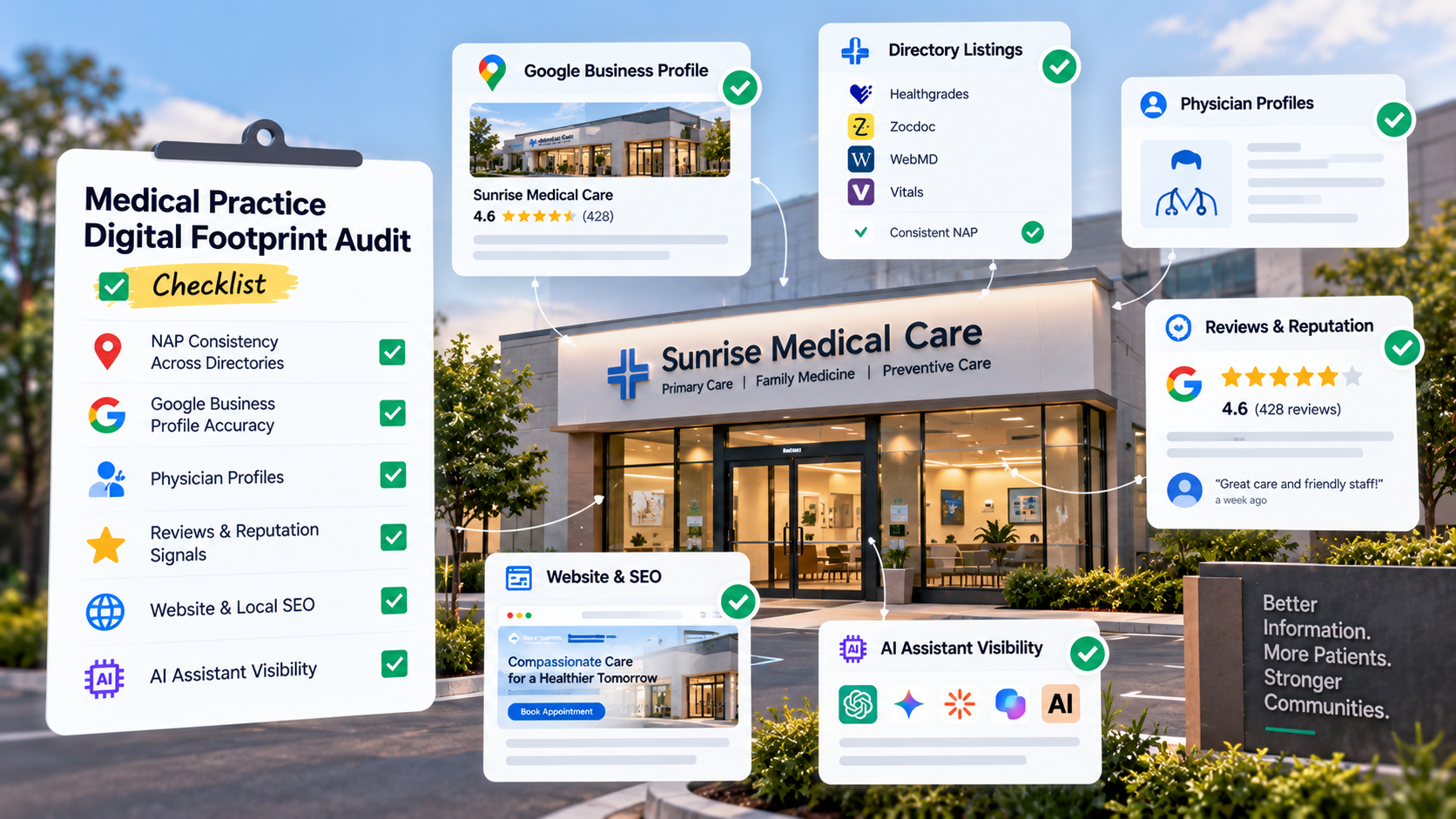
A thorough clinic digital presence checklist usually spans five categories:
- Directory and citation accuracy (where your practice is listed and whether the details match)
- Google Business Profile and map listings
- Individual physician profiles, separate from the practice-level listing
- Reviews and reputation signals
- Website, local SEO fundamentals, and emerging AI-assistant visibility
Below is a working checklist for each.
The Medical Practice Digital Footprint Audit Checklist
1. NAP Consistency Across Directories
NAP stands for name, address, and phone number, and consistency across directories is one of the more well-documented local SEO factors. BrightLocal's research and guidance describe NAP consistency as a significant signal search engines use to judge whether a business listing is trustworthy, and inconsistent NAP data across directories is one of the more common reasons a practice underperforms in local search results (BrightLocal, NAP guide; BrightLocal, citations).
To check this yourself:
- Search your practice name plus city and scan the first two pages of results.
- Check major directories: Google Business Profile, Bing Places, Apple Maps, Healthgrades, Zocdoc, Vitals, WebMD, and your malpractice carrier's public directory if applicable.
- Note every variation in suite number, phone number format, or business name abbreviation.
- Flag listings tied to a prior address or a provider who has since left the practice.
If you operate more than one location, this step gets considerably harder to do manually, since each location needs its own clean set of listings and the risk of cross-contamination (one location's phone number showing up on another's listing) goes up. Practices in that situation often benefit from the more structured approach covered in digital presence management for multi-location healthcare organizations, which addresses how to keep location-specific data separate and accurate at scale.
2. Google Business Profile Accuracy
Your Google Business Profile is frequently the first thing a prospective patient sees, often before your website. Google's own guidance for medical practices specifies that business name, address, phone number, hours, and category need to stay accurate and consistent, and healthcare listings carry additional restrictions, including limits on certain photo types and review content due to privacy considerations (iHealthSpot, Google Business Profile guidelines for medical practices).
Checklist items:
- Confirm the primary category matches your actual specialty (a family medicine practice listed under "doctor" generically is leaving precision on the table).
- Verify hours, including holiday hours and any walk-in versus appointment-only distinctions.
- Check that attributes (wheelchair accessible, accepts new patients, telehealth available) reflect current reality.
- Review the Q&A section, which anyone can post to and which practices rarely monitor.
- Confirm the profile is claimed and verified under practice ownership, not an old marketing vendor's account.
3. Individual Physician and Provider Listings
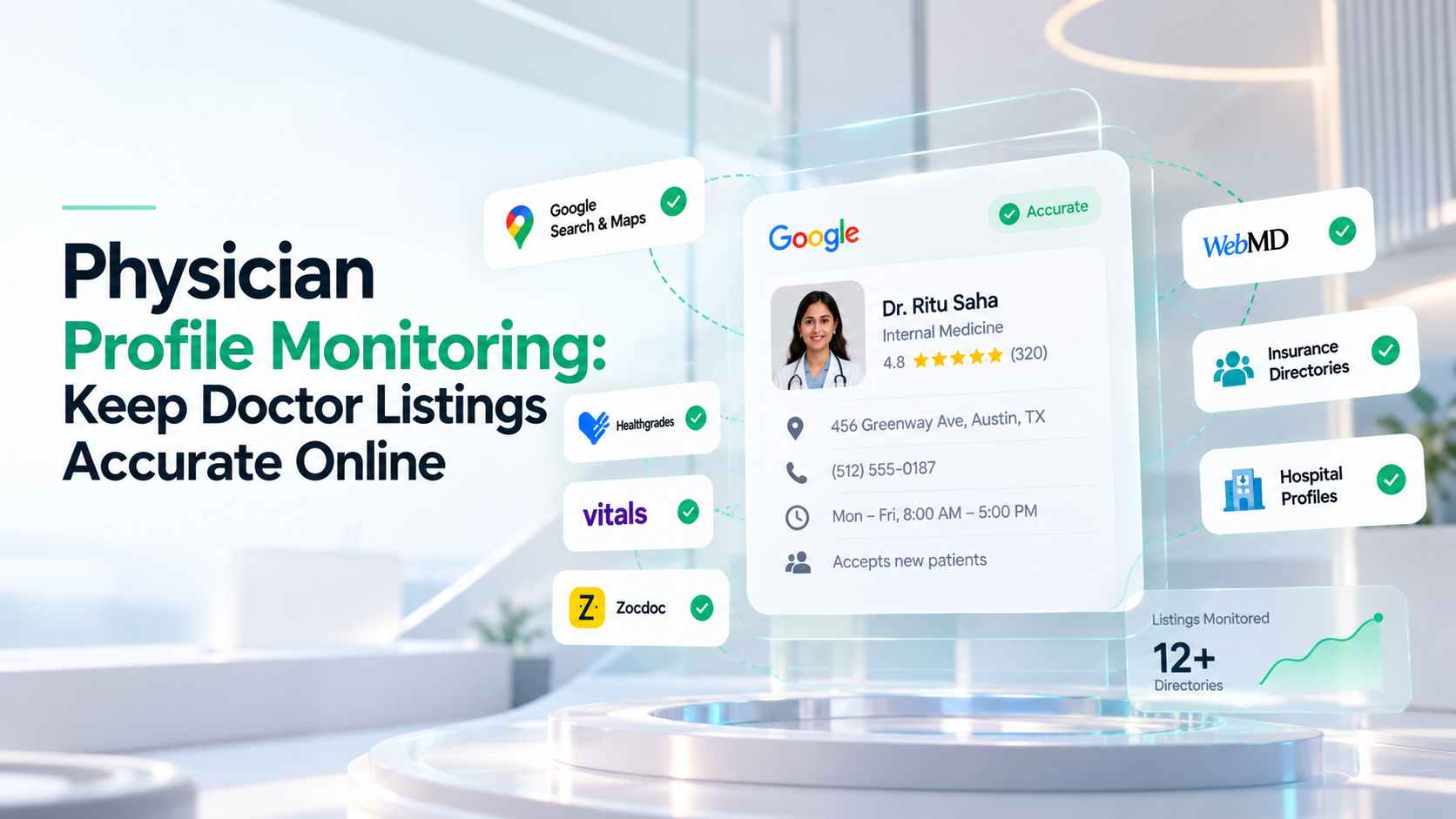
A practice-level audit is incomplete if it stops at the organization and ignores individual providers. Each physician typically has their own listings on Healthgrades, Vitals, Zocdoc, state licensing boards, hospital affiliation pages, and insurance network directories, and these often drift out of sync with the practice's own records, especially after a provider changes locations, adds a specialty, or leaves the group entirely.
Checking this manually for a handful of providers is tedious but doable. For groups with a dozen or more providers, or for agencies running this audit across multiple client practices, it becomes a tracking problem as much as a correction problem. Physician profile monitoring covers how to keep individual doctor listings accurate on an ongoing basis rather than catching errors only during periodic manual reviews.
4. Reviews and Reputation Signals
Given the research cited above showing that negative review proportion and complaint type measurably affect patient choice, reviews deserve a dedicated section of any medical practice digital footprint audit checklist, not a quick glance.
What to check:
- Overall star rating and review count on Google, Healthgrades, and any specialty-specific platform relevant to your field.
- Response rate: how many reviews, positive and negative, have a practice reply.
- Recency: a 4.8-star rating built entirely from reviews three years old reads differently to patients than one with steady recent activity.
- Patterns in negative reviews: complaints about wait times, billing, or front-desk interactions are operational issues an audit can surface even if the clinical care itself is strong.
- Compliance: confirm no review responses disclose protected health information, even inadvertently, when addressing a complaint.
Because review signals change constantly and manual review checks go stale within weeks, this is one of the areas where ongoing tracking matters more than a single pass. Healthcare reputation analytics goes deeper into how to measure patient trust signals over time rather than treating reputation as a one-time audit line item.
5. Website and Local SEO Fundamentals
- Confirm your website's displayed NAP matches your Google Business Profile exactly, including suite numbers and phone formatting.
- Check that each location (if applicable) has its own dedicated page rather than one generic "locations" list.
- Verify mobile load speed and that appointment request forms or scheduling links actually work (a surprising number of broken "Book Now" buttons survive for months unnoticed).
- Confirm schema markup for medical organization or physician, if your site uses structured data, reflects current specialties and providers.
6. Emerging AI Assistant Visibility
Patients increasingly ask AI tools and chat assistants questions like "find a dermatologist near me" or "who takes [insurance] near [city]," and these tools pull from a mix of structured web data, review platforms, and listing accuracy rather than a single ranking system. There's no established measurement standard yet for how a practice shows up in AI-generated answers the way there is for traditional search rankings, so treat this as a developing area to watch rather than a metric to chase precisely. The practical takeaway is that the same fundamentals, accurate listings, consistent NAP data, and clean review signals, are what feed these newer channels as well, so getting the basics right pays off across both traditional and AI-driven search.
7. Competitive Context
A number by itself (3.9 stars, 42 reviews) means little without context. Checking a handful of comparable practices in your specialty and geographic area, using a simple side-by-side comparison of star ratings, review volume, and listing completeness, turns raw numbers into a useful healthcare online presence score for medical practices that reflects where you actually stand rather than an arbitrary benchmark. Some practices build this comparison manually in a spreadsheet; others use a medical practice online presence comparison tool built for the purpose, which saves time once you're tracking more than two or three competitors.
How Often Should You Repeat This Audit?
A full manual run-through once a quarter is a reasonable baseline for a single-location practice. Multi-location groups, or practices with frequent provider turnover, generally need more frequent checks since a single new hire or departure can create listing inconsistencies across a dozen directories within weeks. Reviews in particular warrant more frequent attention than most of this checklist, since a cluster of negative reviews can accumulate and affect patient decisions well before a quarterly audit would catch it.
DIY Checklist vs. a Monitoring Platform
Running this checklist manually works fine for a single-location practice doing it once or twice a year. It becomes genuinely time-consuming once you're managing multiple providers, multiple locations, or recurring reviews across several platforms, which is where a clinic digital presence monitoring platform earns its keep: rather than manually re-checking two dozen directories every quarter, the practice gets ongoing alerts when something drifts out of sync.
This distinction matters for two different audiences reading this checklist:
- Practices and medical groups evaluating whether to handle this in-house or invest in digital presence management software for medical groups that consolidates listings, reviews, and profile accuracy into one view instead of a dozen separate logins.
- Marketing agencies serving healthcare clients, who often need a white label digital presence audit for doctors they can run across an entire client roster and hand off under their own branding, rather than manually repeating this checklist for each client separately.
Either way, the checklist above is the right starting point: know what "accurate" looks like before deciding whether to automate the checking.
A Simple Way to Start
If you haven't run a digital footprint audit before, start narrow. Pick your Google Business Profile and your three most-visited review platforms, verify NAP consistency across those alone, and read through your last twenty reviews. That smaller pass usually surfaces the most urgent issues (a wrong phone number, an unanswered string of negative reviews, a provider who left two years ago still listed as active) without requiring a full day of work.
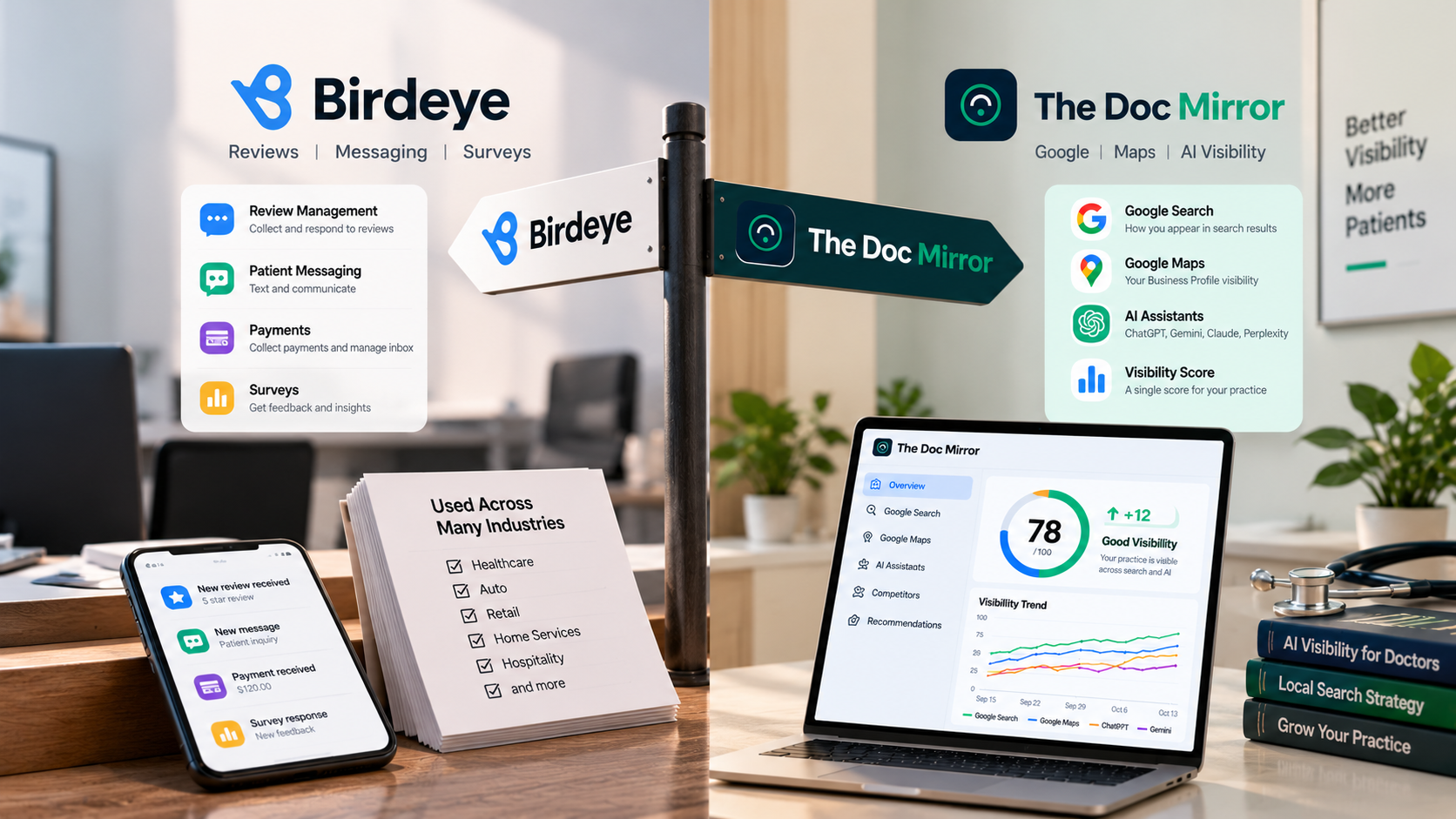
From there, a broader medical practice online visibility audit service, whether run internally with the checklist above or through a platform built for ongoing monitoring, can extend the same process across every location, provider, and review channel on a recurring basis. If you want a starting snapshot of where your own practice currently stands, The Doc Mirror offers visibility tracking across Google listings, reviews, and emerging AI assistant channels, which is a reasonable way to see your current state before deciding how deep to go on an ongoing basis.
Sources
- Yaraghi N, Wang W, Gao GG, Agarwal R. "How Online Quality Ratings Influence Patients' Choice of Medical Providers: Controlled Experimental Survey Study." Journal of Medical Internet Research, 2018. https://www.jmir.org/2018/3/e99/citations
- "Effect of Negative Online Reviews and Physician Responses on Health Consumers' Choice: Experimental Study." JMIR (via PMC), 2024. https://www.ncbi.nlm.nih.gov/pmc/articles/PMC10966444/
- BrightLocal. "What is NAP in Local SEO?" https://www.brightlocal.com/learn/what-is-nap/
- BrightLocal. "Why Local Citations Are Key for Local SEO." https://www.brightlocal.com/learn/local-seo-and-citations/
- iHealthSpot. "Google Business Profile Guidelines for Medical Practices." https://www.ihealthspot.com/blog/google-business-profile-guidelines-and-requirements-for-medical-practices/