E-E-A-T for Doctors: The Trust Signals Google and AI Actually Check
E-E-A-T stands for Experience, Expertise, Authoritativeness, and Trustworthiness, the framework Google uses to judge whether content, including a doctor's website, deserves to rank and be cited. Google Search Central has documented this framework for years as part of its Search Quality Rater Guidelines. It applies extra scrutiny to medical content, because Google classifies health information as "Your Money or Your Life," a category where inaccurate content can cause real harm. For a doctor, this is not an abstract ranking concept. It shapes whether a practice's website, profile, and reviews are trusted enough to appear in Google search results, Google AI Overviews, and answers from AI assistants like ChatGPT and Google Gemini.
This article breaks down what each part of E-E-A-T actually means for a medical website, not the vague version repeated across generic SEO blogs. It covers what counts as real experience signals, how expertise gets demonstrated in content, what authoritativeness looks like outside your own site, and what trustworthiness requires on the page itself. It ends with a practical checklist and answers to the questions doctors ask most about E-E-A-T. SEO for doctors overall covers the wider strategy this fits inside.
What E-E-A-T Means and Why Google Treats Medical Content as "Your Money or Your Life" Content
E-E-A-T is not a single ranking factor Google plugs into an algorithm. It is a framework described in Google's Search Quality Rater Guidelines, used by human raters to evaluate whether content and its author are trustworthy enough to serve searchers well. Google has stated, through Google Search Central, that these guidelines inform how its systems are trained and evaluated, even though E-E-A-T itself is not a direct scoring input.
The "Your Money or Your Life" designation matters because it changes how strictly that framework gets applied. Google defines YMYL pages as those that could significantly affect a person's health, financial stability, or safety if the information is inaccurate or misleading. Medical content sits squarely inside this category, alongside financial advice and legal guidance, because a wrong answer about symptoms, treatment, or medication can cause real harm.
This is why a personal blog about a hobby can rank with thin author credentials, while a page describing symptoms of a heart condition cannot. Google's quality raters are instructed to hold YMYL content to a higher standard for each part of E-E-A-T. They check who wrote it, what qualifies them, whether the content is accurate, and whether the site as a whole can be trusted with a health decision.
For a doctor's website, the stakes are higher than for most small business categories. A local bakery rarely needs to prove the baker's credentials. A page about post-surgical recovery timelines does. That distinction is the starting point for treating E-E-A-T as something to build deliberately, not something to hope shows up on its own.
Experience: Real Credentials and Author Bios That Actually Identify a Person
Google added the second "E" for Experience to its guidelines in December 2022, explicitly to capture whether content was created by someone with first-hand, real-world knowledge of the topic. For medical content, this is the clearest and most concrete part of E-E-A-T to act on.
An author bio that says "Written by Staff" or carries no name at all signals the opposite of experience. A bio naming the doctor, their medical degree, board certification, specialty, and years practicing gives Google, and a human reader, a specific person to evaluate. That bio should appear on every page the doctor authored or medically reviewed, not buried once on an About page.
Experience also shows up in how content is written. A blog post about recovering from knee replacement surgery reads differently when it includes details a treating orthopedic surgeon would actually know, typical timelines, common setbacks, what patients ask most. Google's raters are instructed to look for exactly this kind of first-hand signal.
Practices that rotate through freelance medical writers without named review lose this signal entirely, even if the underlying facts are correct. Every clinical page needs a named, credentialed author or medical reviewer, ideally linking to a state license lookup or hospital affiliation page.
Expertise: Content Depth and Accuracy That Hold Up to Scrutiny
Expertise is about the content itself, whether it demonstrates genuine subject knowledge rather than surface-level explanation. A page that lists five symptoms of a condition without context reads as thin. A page that explains when those symptoms warrant an urgent visit versus a scheduled appointment reads as expert.
Depth does not mean length for its own sake. A 3,000-word article padded with repetition demonstrates less expertise than an 800-word page that answers the specific question a patient typed into Google, directly and completely. Google Search Central has repeatedly stated that content should be created for people first, answering real questions with genuine insight, not written primarily to match a keyword.
Accuracy is non-negotiable for medical content in a way it is not for most topics. A single factual error, an outdated dosage guideline, an incorrect recovery timeline, undermines the expertise signal for the entire page, and potentially the whole site if Google or a reader catches it. Sourcing claims to established medical bodies, and reviewing content on a schedule rather than publishing it once and leaving it, protects that accuracy over time.
The most effective medical content answers the exact questions patients ask, using the same language patients use, backed by a named clinician's actual knowledge. Content that demonstrates expertise directly tends to outperform generic explainer pages, both for search rankings and for how AI assistants pull and cite information when summarizing patient questions.
Authoritativeness: What Validates a Doctor Outside Their Own Website
Authoritativeness is the part of E-E-A-T a practice cannot fully control by editing its own site, because it depends on how other sources describe and reference that doctor. Google Search Central has described authoritativeness as a measure of reputation, particularly among other experts and publications in the same field.
For a doctor, this shows up as consistent listings across medical directories like Healthgrades, Zocdoc, and WebMD. It also includes correct affiliation on a hospital or health system's own website, and mentions or citations from local news, medical associations, or academic sources. Each of these functions as a third party effectively vouching for the doctor's standing.
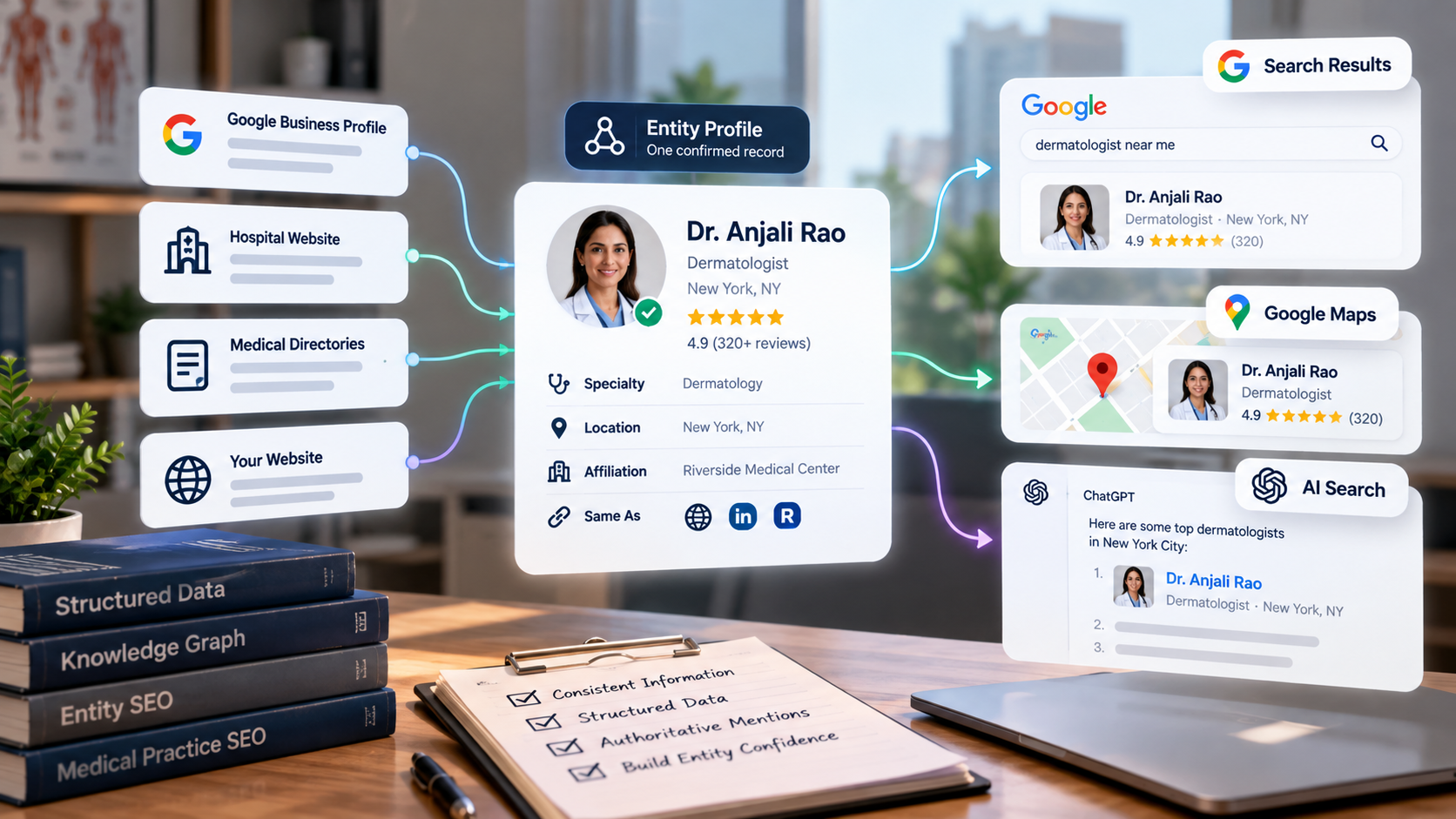
A single strong external mention rarely moves the needle by itself. What matters more is the pattern: a doctor named consistently, with the same credentials and specialty, across enough independent sources that Google's systems can corroborate the same facts. This corroboration is part of what allows Google, and increasingly AI assistants, to treat a doctor as a recognized entity rather than just a set of pages.
That entity recognition is exactly how that authority gets recognized by AI, since AI assistants draw on the same kind of cross-referenced signals when deciding whether to name a specific doctor in an answer. Building authoritativeness, in other words, is not just an SEO exercise. It increasingly determines whether a doctor gets mentioned by name when a patient asks ChatGPT or Google Gemini a health question.
Trustworthiness: The Baseline Signals a Site Cannot Skip
Trustworthiness is the foundation E-E-A-T sits on, and Google Search Central has said that without it, high scores in experience, expertise, or authoritativeness matter less. A site can appear knowledgeable and still fail this test if basic trust signals are missing or wrong.
Accurate, consistent contact information is the simplest version of this. A practice's name, address, and phone number should match exactly across the website, Google Business Profile, and every directory listing. A phone number that rings a disconnected line, or an address that no longer matches the current location, damages trust immediately for both patients and Google's systems.
A secure site, meaning one served over HTTPS, is now a baseline expectation rather than a differentiator. Beyond that, a clear privacy policy, a visible way to contact the practice, and transparency about who owns and operates the site all signal that a practice has nothing to hide. Sites that obscure ownership or bury contact details behind a form read as less trustworthy, regardless of how well-written the content is.
Reviews function as a trust signal too. A high star rating alone does not impress Google. What matters more is a consistent pattern of real, recent reviews at a credible volume, corroborating that a practice operates as described.
What Most Medical Sites Get Wrong About E-E-A-T
The most common mistake is treating E-E-A-T as a technical setting to switch on, like adding a plugin or a schema markup tag. It is a pattern Google infers from real signals across a site and the web, built over time rather than fixed in an afternoon.
A close second is publishing content with no named author or medical reviewer at all. Many practice websites still carry generic "Admin" bylines, which erases the experience signal entirely, even when the underlying medical information is accurate.
A third mistake is relying on AI-generated content published without a clinician's review. Content written quickly to fill a blog calendar, without a named doctor checking accuracy, tends to read as generic and often contains subtle errors that undermine trust once discovered.
A fourth mistake is focusing entirely on the practice's own website while ignoring directory listings, hospital pages, and third-party mentions that are wrong or outdated. A doctor who moved practices two years ago but still appears at the old address on five directories works against their own authoritativeness.
The final mistake is treating E-E-A-T as a one-time project. Credentials change, staff turn over, addresses move, and content ages. A practice that built strong signals two years ago and never revisited them is likely losing ground to competitors who keep theirs current.
A Practical E-E-A-T Checklist for Doctors
- Add a named, credentialed author or medical reviewer bio to every clinical page, including degree, board certification, and specialty.
- Link each bio to a verifiable source, such as a state license lookup or hospital affiliation page.
- Review clinical content at least annually, and correct anything outdated or inaccurate.
- Confirm your practice name, address, and phone number match exactly across your website, Google Business Profile, and every directory.
- Confirm your site runs on HTTPS and has a visible privacy policy and contact method.
- Audit your presence on major medical directories and hospital pages for outdated or incorrect information.
- Keep gathering real, recent patient reviews, since volume and recency both function as trust signals.
- Avoid publishing AI-generated content without a named clinician reviewing it for accuracy first.
- Revisit all of the above regularly, since E-E-A-T reflects an ongoing pattern, not a fixed state.
Conclusion
E-E-A-T is not a mysterious algorithm update to chase. It is Google's documented explanation of what separates a trustworthy medical website from one it cannot confidently recommend to someone making a health decision. Experience, expertise, authoritativeness, and trustworthiness show up as concrete, checkable signals, not vague brand impressions.
For doctors, building these signals deliberately pays off in more than search rankings. The same signals increasingly determine whether AI assistants recognize a doctor by name when patients ask health questions directly.
The Doc Mirror shows exactly which E-E-A-T signals your practice is missing right now, across Google search, Google AI Overviews, and the leading AI assistants patients use to find and evaluate doctors. Run an audit of your current trust signals and see precisely where you stand.
By the The Doc Mirror team