Medical Entity SEO: How Search Engines and AI Decide Who You Are
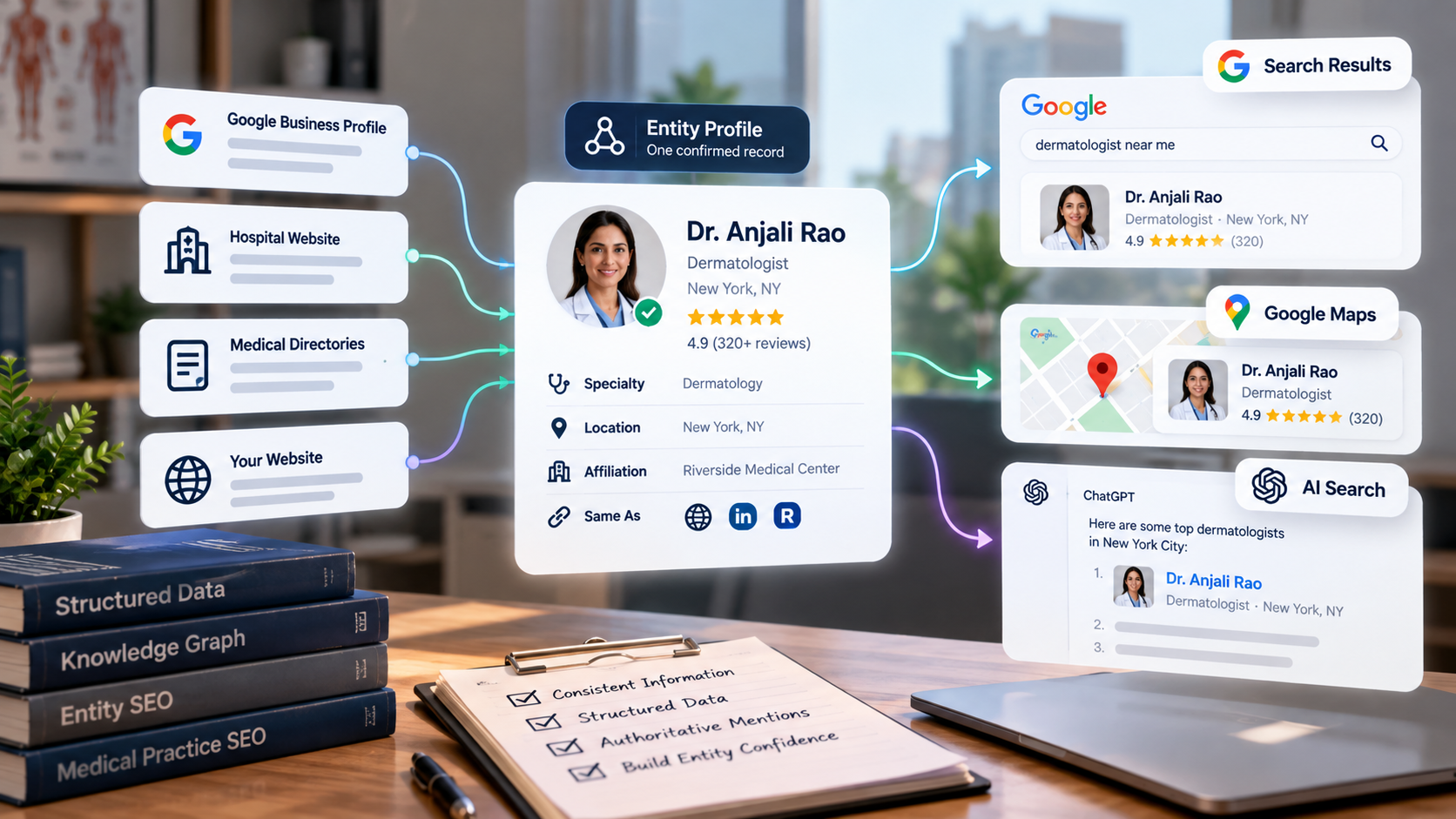
Medical entity SEO is the technical process by which search engines and AI assistants convert scattered mentions of a doctor into one confirmed record inside their internal knowledge systems. Before Google or ChatGPT can name you in an answer, both have to decide, computationally, that "Dr. Anjali Rao" on your website, on your Google Business Profile, and on a hospital staff page all point to the same real person. That decision is not a judgment call made by a human reviewer. It runs on structured data, corroboration across sources, and a confidence calculation that either clears a bar or does not.
This article explains the mechanism, not the checklist. It covers what an entity actually is to a machine, how confidence in that entity is built and eroded, and why AI assistants behave differently from traditional search results once that confidence is in place. For the practical, step-by-step work of building your entity profile, the practical steps to build one are covered in full elsewhere. This page exists so you understand why those steps work.
What an entity actually is to a search engine or AI system
A webpage is a document. A keyword is a string of text someone types into a search box. An entity is neither. It is a discrete, real-world thing, a specific person, place, or organization, that a knowledge system has identified and connected to other known facts about it.
Google's Knowledge Graph is the clearest public example. It does not store your webpage as the object of interest. It stores a node representing you, the physician, with attributes attached: a name, a specialty, a location, a relationship to a clinic or hospital. Your webpage is one piece of evidence the system uses to populate and confirm that node, not the node itself.
This distinction matters because it changes what "optimization" means. Optimizing a webpage for a keyword is about matching text to a query. Optimizing an entity is about giving a knowledge system enough consistent, corroborated evidence to conclude that a specific database record refers to a specific, real practice. AI assistants built on large language models work from a related idea. They do not query a live database the way Google Search does, but their outputs still depend on entities being distinguishable rather than blurred together. A model that cannot separate you from a namesake two states away has no reliable way to recommend you specifically.
How entity confidence gets built
Confidence is not a single signal. It is the accumulated weight of independent sources agreeing with each other, and it is worth understanding what each type of evidence actually contributes.
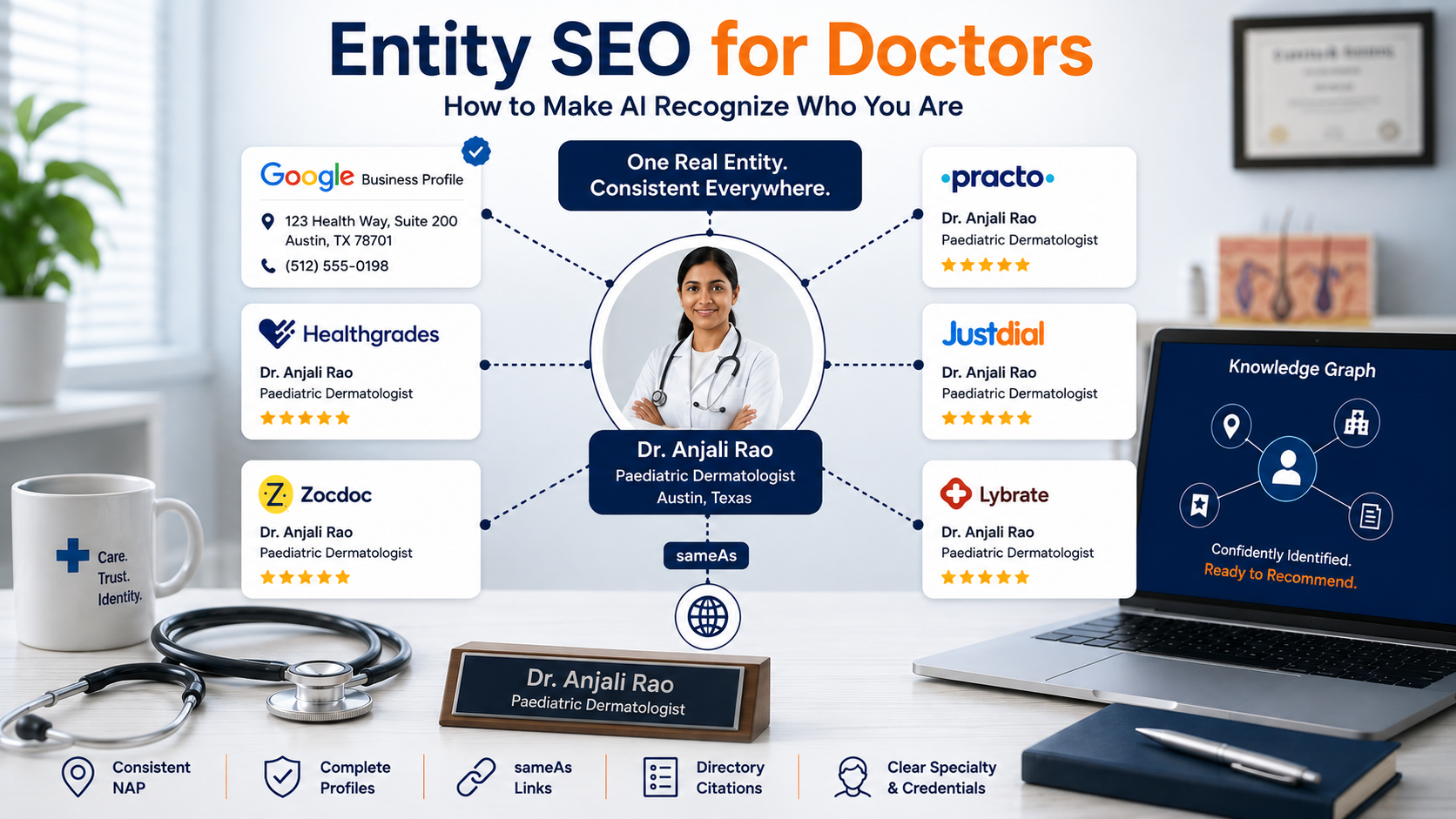
Consistency across sources. When your name, address, phone number, and specialty appear identically across your website, your Google Business Profile, and third-party directories, each matching instance functions as independent corroboration. A knowledge system treats agreement across unrelated sources as stronger evidence than repetition on one source, because independent agreement is harder to fake by accident. A single inconsistency does not necessarily break recognition, but it lowers the confidence attached to the record, and small inconsistencies compound into real ambiguity.
Structured data. Schema markup, such as the Physician or MedicalClinic types defined by schema.org, exists to make entity attributes machine-readable rather than requiring a system to infer them from unstructured text. A sameAs property in that markup is a direct, explicit statement that two URLs describe the same entity, which is a stronger signal than a system inferring the connection on its own. Structured data does not manufacture confidence out of nothing. It makes existing agreement legible faster.
Authoritative mentions. Not every source carries equal weight. A mention on a hospital's official staff page, a state medical board listing, or an established health directory contributes more to confidence than one on a low-authority site. The system already has independent reasons to trust that source. This is closely related to why Wikidata and Wikipedia function as strong entity anchors across the wider web, since systems tend to treat well-governed, frequently verified reference sources as reliable ground truth.
None of this is a fixed formula a practice can reverse-engineer exactly. Google and AI developers do not publish the precise weighting behind entity resolution, and any claim to know the exact algorithm should be treated with skepticism. What is well established is the general shape: agreement across independent, credible sources builds confidence, and disagreement erodes it.
What low confidence looks like in practice for a doctor
Low entity confidence rarely announces itself. It shows up as small, specific failures rather than a single visible error message.
A search for your name returns a knowledge panel for the wrong person, or no panel at all, even though a less established colleague has one. An AI assistant asked to recommend a specialist in your area lists two or three names and skips you, despite your qualifications matching closely. Your Google Business Profile and website list slightly different suite numbers, and a directory still shows an address you left two years ago.
Each of these is a symptom of the same issue. The system has evidence pointing at you, but that evidence does not agree cleanly enough to clear the threshold required to act on it. Its safest response to ambiguity is not to guess. It is to hedge, stay silent, or default to whichever record is cleaner, even if that record belongs to someone else with a similar name.
How this connects to AI assistant recommendations specifically
Traditional search results can afford to be imprecise, because a ranked list gives the user ten options to sort through themselves. An AI assistant answering "who is a good pediatric dermatologist near me" typically names one to three practices directly, in prose, with no ranked list as a fallback.
That shift raises the cost of low confidence. A search engine with moderate confidence in your identity might still rank your page reasonably well, because the user does part of the disambiguation by scanning a list. An AI assistant with the same moderate confidence has a stronger incentive to omit you entirely. Naming the wrong doctor in a direct medical recommendation carries real risk for the assistant, and more importantly, for the patient.
This is why entity confidence sits underneath everything else in AI visibility rather than being one factor among many. Good content, positive reviews, and strong local rankings matter less if the system cannot first confirm which specific doctor it is evaluating. Getting the identity layer right is what makes every other signal usable. Getting AI assistants to act on those signals once your entity is confirmed is a separate, related piece of the work.
What most people get wrong about entity confidence
The most common misunderstanding is treating entity SEO as a one-time setup task rather than an ongoing state that can erode. A practice that builds a clean entity profile in one year can drift out of alignment within two or three years. New directories appear, old ones go stale, and small details get updated in one place but not another.
A second mistake is assuming more mentions always help. Volume without agreement does not raise confidence. Thirty directory listings with three different address formats create more ambiguity than ten listings that match exactly, because the system now has more conflicting evidence to reconcile.
A third mistake is conflating entity SEO with general SEO or content marketing. Ranking well for a keyword and being confidently recognized as a distinct entity are related but separate outcomes. Entity work sits closer to identity infrastructure than to content strategy, which is part of why it gets overlooked until an AI assistant quietly names someone else instead.
Where to act on this
This page covers the mechanism behind entity confidence, not the step-by-step build. The concrete work, claiming and aligning your Google Business Profile, adding sameAs links, standardizing your NAP across directories, and disambiguating yourself from doctors with similar names, is covered in the practical steps to build one.
Entity SEO is one layer of a wider discipline. If starting from scratch, situate this work inside SEO for doctors overall, since entity confidence supports the rest of your visibility work rather than replacing it.
Conclusion
Entity confidence is the mechanism underneath every AI recommendation a doctor either gets or misses. It is built from consistent details, structured data that makes those details legible, and corroboration from sources a knowledge system already trusts. Understanding the mechanism does not replace doing the work, but it explains why small inconsistencies matter more than they seem to on the surface.
The fastest way to see where your own entity confidence stands is to check how AI assistants currently see your entity. The Free Audit runs your practice across Google, ChatGPT, Gemini, Claude, Perplexity, and directories, and shows where your identity is confirmed and where it is still ambiguous.
Run your free audit at thedocmirror.com
By the The Doc Mirror team