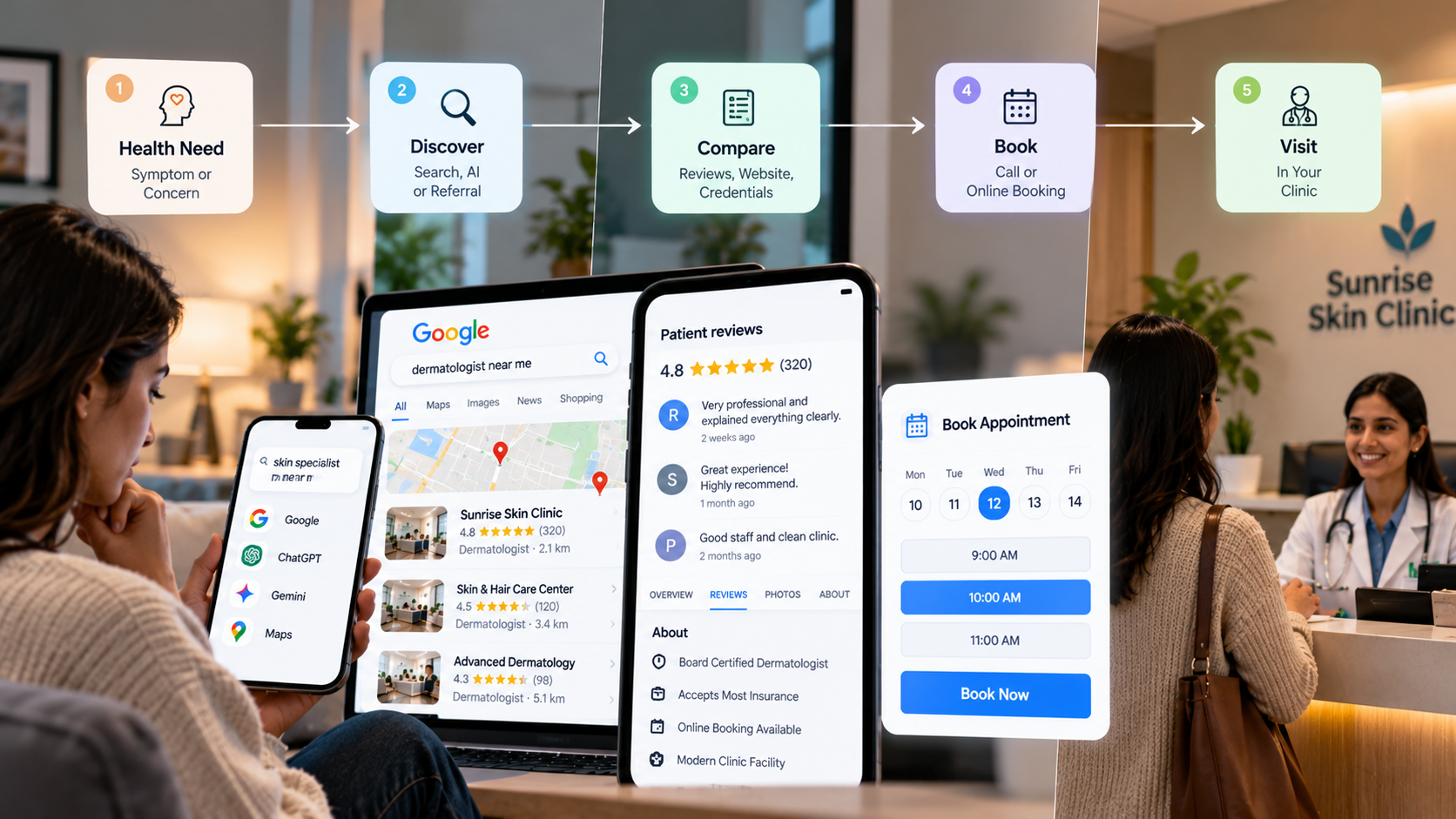
The Online Patient Journey: How Patients Discover, Compare, and Book a Doctor
The online patient journey is the sequence a patient moves through from noticing a health need to sitting in your waiting room, and it usually runs through search, comparison, and a booking decision before a single word is exchanged with your staff. Most doctors picture this as one moment: a patient searches, finds the practice, and calls. The reality involves several stops, spread across search engines, AI assistants, review pages, and a practice's own website, often within the same day.
Understanding the full sequence matters because a practice can be strong at one stage and invisible at another. A single weak stage can end the path before a patient ever reaches the phone. The Doc Mirror tracks how practices show up at each of these stops, from the first search to the AI assistant answer to the booking page.
This article walks through the entire online patient journey stage by stage, points out where practices typically lose people along the way, and gives you a way to audit your own journey today.
The Trigger: What Starts the Search
Every patient journey starts with a reason, not a random search. The three most common triggers are a new or worsening symptom, an insurance change that forces a search for an in-network doctor, and a referral from another doctor, a friend, or a family member. A fourth trigger is circumstantial: someone moves to a new city, ages into needing a specialist, or loses a doctor who retires or leaves a practice.
The trigger shapes urgency. A patient with sudden chest pain searches differently than a patient calmly comparing pediatricians before a move. A practice that assumes every patient arrives with the same intent will misjudge both.
Discovery: Where Patients Actually Look First
Once a patient is motivated to look, they reach for the tools most people reach for. 77% of patients use search engines to find a doctor, which keeps Google the default starting point for most searches. A referral or a friend's recommendation can shortcut this stage, but even then, most patients still open a search engine to confirm the name.
A referral or word of mouth often produces a brand search instead of a generic one, where a patient types a specific doctor's or practice's name directly into Google rather than searching by specialty. That search still passes through many of the same trust signals, since patients frequently confirm a name before calling, checking the profile and reviews attached to it.
AI assistants are changing what discovery looks like. A patient can now ask ChatGPT or Google Gemini for a recommendation directly and get one to three named practices back, without seeing a ranked list of websites first. Whether a practice appears in that answer depends on many of the same underlying signals that decide search visibility elsewhere. For the full breakdown of what determines whether patients can find you in the first place, see what online visibility actually means.
Comparison: Narrowing the List
Discovery rarely produces one name. It produces a short list, usually a handful of practices a patient will weigh against each other before deciding. Patients check an average of 3 sources before choosing a doctor, moving between Google reviews, a practice's website, and sometimes a directory or hospital page before making a call.
Reviews do most of the persuading at this stage. 72% of patients trust online reviews as much as personal recommendations, which means a stranger's write-up on Google now carries roughly the same weight as a friend's advice once did. Rating, review count, and how recently reviews were left all factor into that trust, alongside photos and how complete the profile looks.
A practice's own website adds credentials, insurance information, and a sense of what a visit will actually involve. For the specific signals that make one doctor look more trustworthy than another at this stage, see the trust signals that matter.
The Decision Moment: What Tips Someone to Book
82% of patients research their doctor online before booking, so by the time someone picks up the phone or clicks a booking link, they have already made most of the decision. The moment itself usually comes down to whichever option feels safest among the names still standing after comparison.
A few small things tip that moment. A patient will often choose the practice with the most recent reviews over the one with a higher average but no update in a year, because recency reads as evidence a practice is still active and cared for. Distance breaks ties between two similarly rated practices, and a visible, working booking link removes the last excuse to keep looking.
The full stage-by-stage breakdown of this decision, including what typically happens right before and after it, is covered in how patients decide to book.
After the Decision: Booking Friction and the First Visit
Deciding is not the same as booking. A patient who has mentally chosen a practice can still be lost in the final step if the path from decision to appointment has friction. A phone line that goes unanswered during stated hours, an online booking form that fails to load, or a wait for a callback that stretches past a day can all send a decided patient back to the list.
The first visit carries its own weight, separate from the search that led there. A confusing check-in process, a long wait past the scheduled time, or a mismatch between what the website promised and what the visit delivered will not undo the booking. It will shape whether that patient leaves a review, returns, or refers anyone else. The online journey does not end at the appointment. It resumes the next time that patient, or someone they know, searches for care.
Where Practices Lose Patients Along the Journey
Every stage above has its own point of failure, and most practices are quietly losing patients at more than one. The most common failure is at the shortlist stage: the top 3 Google results get roughly 68% of all clicks, which means a practice sitting in position five or six is effectively invisible to most people searching, regardless of the quality of care behind it.
A second common failure point is a stale profile. A practice with strong care but a review page that has not been updated in eight months looks less trustworthy in comparison than a newer, less experienced practice with a steady flow of recent reviews.
A third failure point is AI assistant absence. A practice can rank well on Google and still be missing entirely from the answer ChatGPT or Google Gemini gives when a patient asks for a recommendation directly, cutting it out of the shortlist before comparison ever starts.
A fourth is booking friction, where a practice wins the comparison stage and still loses the patient at the final click or call. For a fuller look at what this pattern actually costs a practice in booked patients, see how much this costs in lost patients.
Auditing Your Own Patient Journey
Walking your own journey the way a patient would takes about 20 minutes and surfaces most of these gaps directly. Open a private browser window and work through the stages in order, the way a new patient would.
- Search. Search your specialty plus your city and note whether your practice appears at all, and where.
- Shortlist. Check whether you are in the Google local pack of three, then ask ChatGPT or Gemini "best [specialty] in [city]" and see if you are named.
- Comparison. Read your rating, review count, most recent review date, and photos the way a stranger would, next to the practices above you.
- Booking. Click through your own booking link and call your own front desk during business hours, noting anything that stalls or fails.
Each stage above maps to one part of this journey, and each gap you find points to a specific fix rather than a general complaint about visibility. For a broader plan that connects these fixes into one marketing approach, see the full marketing playbook.
A single walkthrough will not catch everything a real patient experiences, since your own familiarity with your practice changes what you notice. That is one reason a structured audit helps more than a manual check.
Conclusion
The online patient journey is not one search and one click. It runs through a trigger, a discovery stage, a comparison stage, a decision moment, and a booking step that can still lose a patient who has already decided. A practice that only pays attention to one of these stages, usually its own website, leaves the rest of the path unmanaged.
The Doc Mirror shows exactly where your practice stands at each stage of this journey, from search and AI assistant visibility to reviews and booking friction, in one visibility score. Run your free audit and see where you drop off in this journey.
By the The Doc Mirror team