AI Rank Tracker for Doctors: What to Look for Before You Pay for One
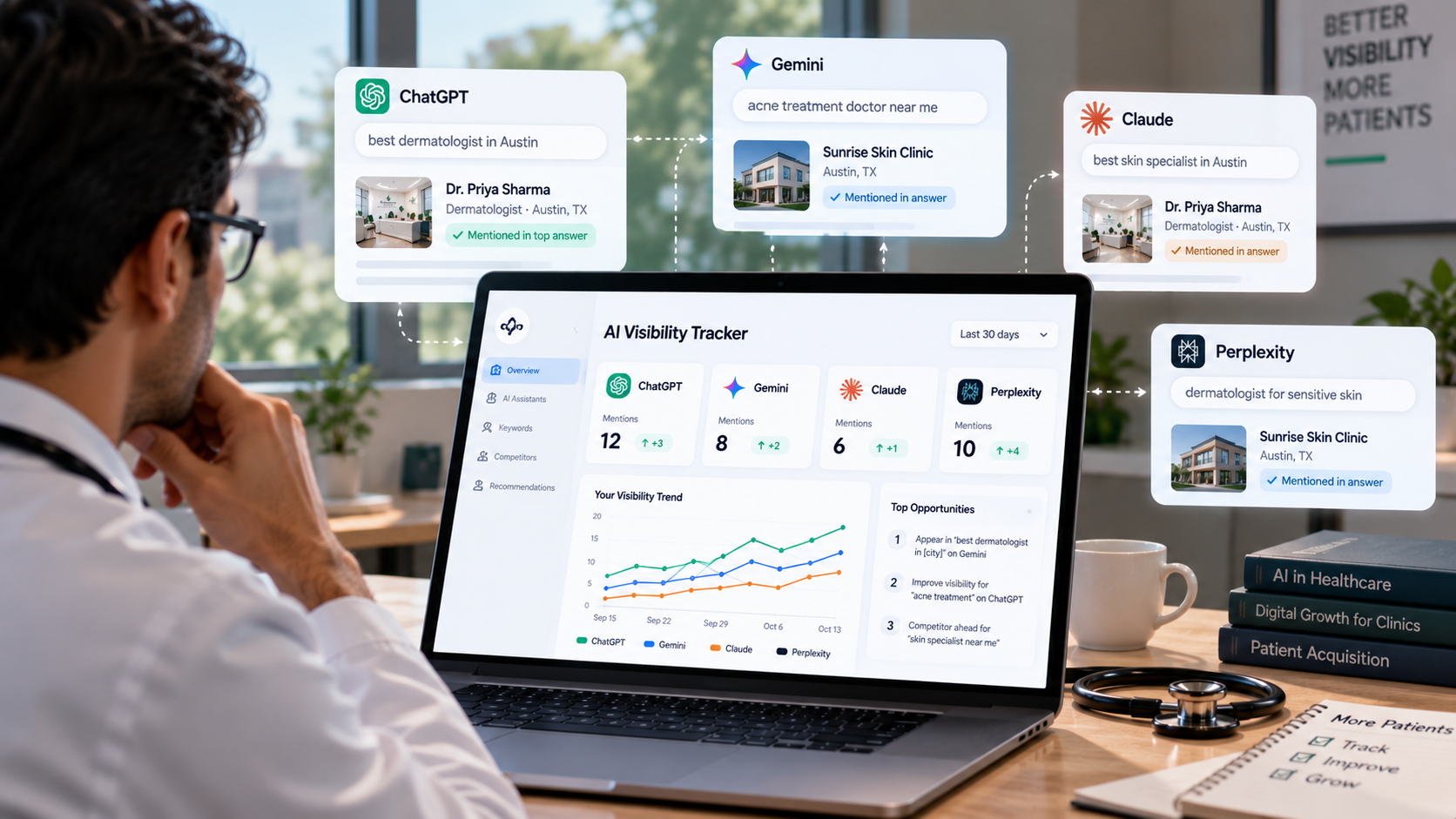
An AI rank tracker for doctors should show you which AI assistants name you, where you rank inside their answers, and whether that position is improving over time. Not every tool that calls itself an AI visibility tracker actually measures the same thing. Some check a single AI assistant once a month and call it tracking. Others log a narrow set of queries that have little to do with what your patients actually ask.
Before you pay for a tracking tool, you need to know what a real one measures, how often it checks, and what it does with that information once it has it. This guide walks through the questions worth asking, the red flags worth avoiding, and how The Doc Mirror's own Monitor product approaches the same job. If you want the mechanics of what tracking AI visibility involves before you evaluate a paid option, read our guide on how to track it yourself first.
Why tracking AI visibility is different from tracking Google rankings
Google rank tracking is a mature category built on a simple fact: search engines return a numbered list of links, and a tool can query that list and record your position on it. AI assistants do not work this way. ChatGPT, Gemini, Claude, and Perplexity generate a written answer, not a numbered list, and there is no public rank-tracking API for any of them.
That absence matters more than it sounds. Every AI rank tracker on the market has to build its own method for turning a generated answer into a number. Some send a fixed list of patient questions and record whether your name appears anywhere in the response. Others go further and note your position within the answer, whether you are the first name mentioned or the third.
Because there is no shared standard, two tools can check the same AI assistant on the same day and report different results for the same practice. One might count a passing mention of your clinic name as an appearance. Another might require your name to appear as part of an actual recommendation before it counts. Before you trust a number, find out how the tool behind it generates that number.
What to evaluate in a tracker
Four questions separate a tracker worth paying for from one that produces numbers without substance.
Which AI assistants does it actually check? ChatGPT, Gemini, Claude, and Perplexity each draw on different sources and often give different answers to the same question. A tracker that only checks one assistant gives you a partial picture, no matter how detailed that single check is. Ask for the exact list of assistants covered before you sign up.
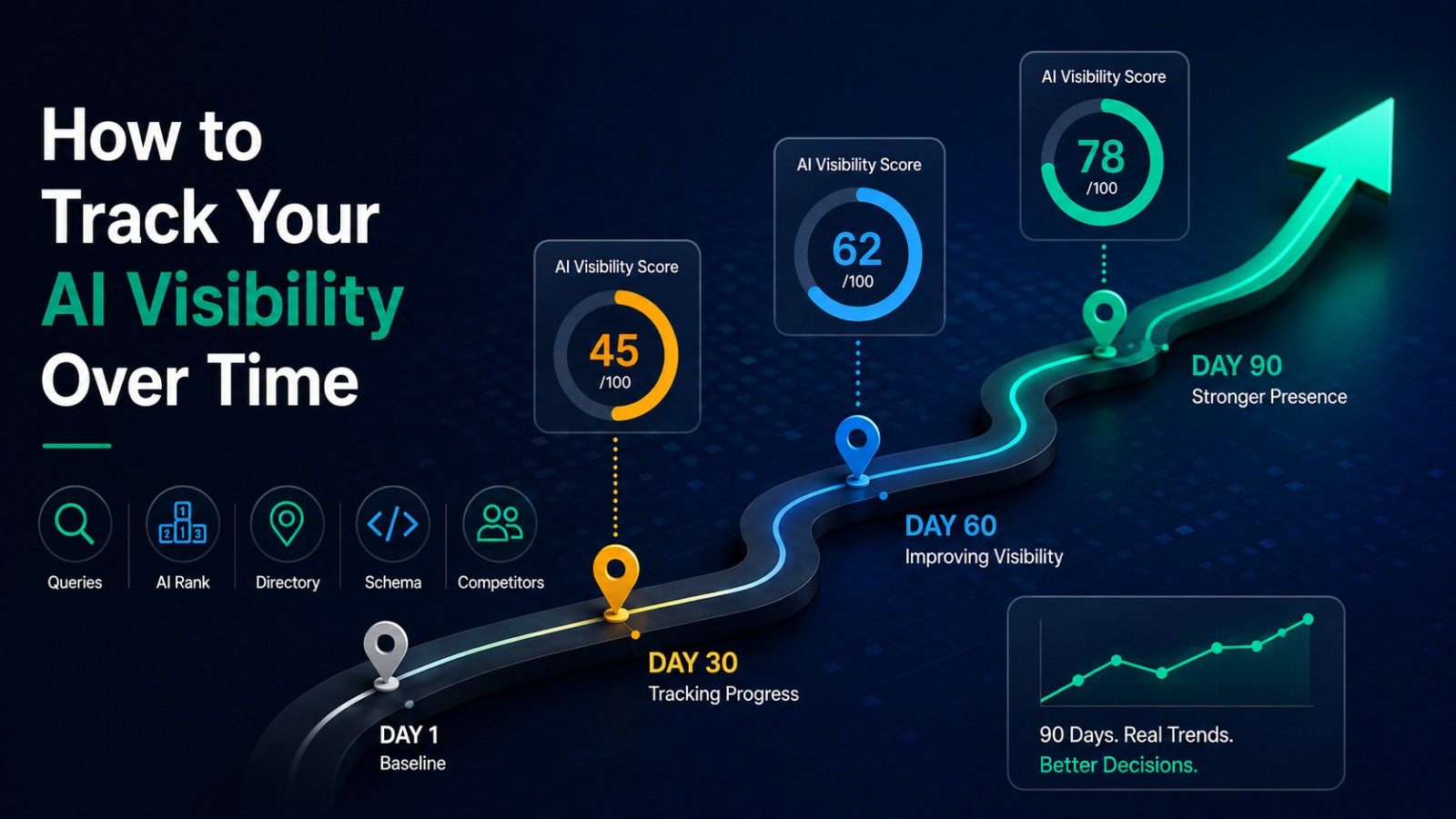
How often does it check, and on what schedule? AI answers can shift within days, so a tool that runs once a month misses most of the movement. Look for a tracker that runs on a fixed weekly schedule and keeps a written history, rather than a series of one-off snapshots that reset each time.
Does it show competitor comparisons? Knowing that you appear for a query is useful. Knowing that a competitor now appears above you, or has started appearing where they did not before, is what tells you something changed. A tracker without competitor visibility only tells you half the story.
Does it connect back to a fix? A number on a dashboard means little if it does not tell you what to do next. The most useful trackers tie a drop in visibility to a likely cause, such as a stale directory listing or missing schema markup, so you know where to act rather than just where you stand.
Red flags to watch for
Some claims are worth walking away from immediately.
Guaranteed AI rankings. No company can guarantee that ChatGPT or Gemini will name your practice, or in what position, because AI assistant outputs are not deterministic. The same question asked twice can return two different answers, even on the same day. A tool that promises a specific ranking outcome is promising something it does not control.
No explanation of methodology. If a tool will not say which assistants it checks, how often, or how it counts an appearance, you cannot judge whether its numbers mean anything. Transparency about method is a basic requirement, not an extra.
A single snapshot sold as tracking. Tracking implies repetition over time. A one-time report, however detailed, is an audit, not a tracker. If a product does not run on a recurring schedule, it is not doing what the word tracker implies.
No path from data to action. A dashboard full of numbers with nothing telling you what caused a change is a reporting tool, not a diagnostic one. Most doctors need help with diagnosis, since knowing you have a problem does not tell you what to fix.
How The Doc Mirror's own Monitor approaches this
We built The Doc Mirror's own weekly Monitor by applying the four questions above to ourselves before asking a doctor to pay for it.
Monitor checks Google, ChatGPT, Gemini, Claude, and Perplexity, plus 6 directories, on a fixed weekly schedule. Each week it records your visibility score across the 7 pillars we use to measure AI visibility. It also flags competitor movement directly, so you know the week a rival starts appearing for a query where they did not before.
Every report ties a change back to a likely cause where one is identifiable, whether that is a stale directory listing or a schema issue on your website. Monitor costs $49 per month in the US and ₹4,199 per month in India.
We do not promise a specific ranking outcome, since no honest tool can. AI assistant outputs are not deterministic, and any vendor claiming otherwise is not being straight with you. What we can promise is a consistent, transparent method applied every week, so this month compares cleanly to last month.
What most doctors get wrong when evaluating these tools
The most common mistake is picking a tool based on how many AI assistants it lists on its pricing page, without asking how it actually checks them. A tool that claims to cover five assistants but checks each one once a month is not meaningfully different from checking manually and writing the answers down yourself.
A second mistake is treating the first report as the whole product. The value of a tracker is in the pattern across weeks and months, not in any single report. If you judge a trial period by comparing one week's numbers to your gut feeling, you are not testing what the product is built to do.
A third mistake is ignoring how a tool defines an appearance. Some count any mention of your practice name, even a passing one buried in a longer answer. Others require your name to be part of an actual recommendation. Ask for a specific example of what counts before you trust the score, so you know whether it matches what a patient would actually see.
Finally, many doctors skip the step of acting on what the tracker shows you. A tracker is a diagnostic tool, not a fix on its own. If you are not making changes based on what it finds, such as correcting a directory listing or adding schema markup, the subscription is only confirming that a problem exists, not solving it.
AI visibility tracking is one piece of a wider strategy, not the whole of it. For the full marketing playbook, covering reviews, local search, and AI visibility together, read our doctor marketing guide.
The bottom line
Paying for an AI rank tracker only makes sense if it does what a spreadsheet cannot: check multiple assistants on a fixed schedule, compare you to competitors, and tell you what to fix. Ask any vendor how they define an appearance, how often they check, and what happens after they find a problem. If they cannot answer clearly, keep looking.
Try Monitor from The Doc Mirror. It checks Google, ChatGPT, Gemini, Claude, and Perplexity, plus 6 directories, every week, scores you across the 7 pillars, and alerts you the week a competitor moves. It costs $49 per month in the US and ₹4,199 per month in India.
By the The Doc Mirror team